
Understanding Bone Pathology: Elevated Alkaline Phosphatase and Developmental Milestones
A 70-year-old man presents with bone pain and elevated serum alkaline phosphatase levels. Histological examination reveals haphazardly-oriented cement lines, indicative of a mosaic pattern of lamellar bone, suggesting a condition such as Paget's disease. The initial lesion of this condition is likely due to osteoblasts. Additionally, we evaluate an infant whose growth is on track; osteoblasts near growth plates convert to osteocytes connected by gap junctions. This scenario underscores the importance of understanding bone cell activity in pathology and normal development.

Understanding Bone Pathology: Elevated Alkaline Phosphatase and Developmental Milestones
E N D
Presentation Transcript
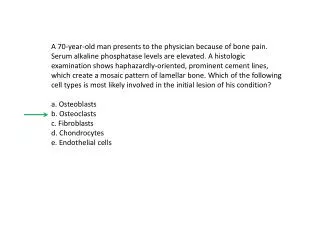
A 70-year-old man presents to the physician because of bone pain. Serum alkaline phosphatase levels are elevated. A histologic examination shows haphazardly-oriented, prominent cement lines, which create a mosaic pattern of lamellar bone. Which of the following cell types is most likely involved in the initial lesion of his condition? a. Osteoblasts b. Osteoclasts c. Fibroblasts d. Chondrocytes e. Endothelial cells
An infant born to a 22-year-old female meets all developmental milestones. His height corresponds to the 60th percentile. Osteoblasts near the growth plates of his long bones convert to osteocytes to remain connected to each other by: a. A tight junctions b. Hemidesmosomes c. Intermediate junctions d. Gap junctions e. Desmosomes