Download
1 / 15
150 likes | 277 Vues
This review delves into Robert Kiyosaki's perspective as shared in his influential book. Raised in Hawaii and shaped by his experiences, including service in Vietnam, Kiyosaki challenges traditional education and promotes financial literacy. He argues that the wealthiest individuals succeed not just through schooling but through understanding financial principles. Key lessons include the importance of assets over liabilities and prioritizing financial education over job security. This insightful guide encourages readers to rethink their approach towards money and wealth-building.

E N D
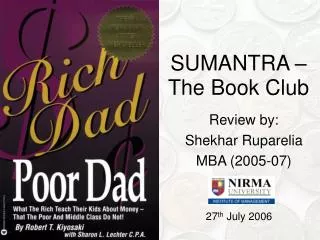
SUMANTRA – The Book Club Review by: Shekhar Ruparelia MBA (2005-07) 27th July 2006
The Author • Born and raised in Hawaii, Robert is fourth-generation Japanese American. • Joined U. S. Marine Corps and went to Vietnam as a helicopter gunship pilot. • In 1977 he founded a company that brought to the market the first nylon and Velcro "surfer" wallets. • Robert created the board game CASHFLOW, which teaches the game of money. Robert Kiyosaki
The Co-Author • She joined what was then one of the big eight accounting firms • Became the CFO of a turnaround company in the computer industry • Tax director for a national insurance company • Founder and Associate Publisher of the first regional woman's magazine in Wisconsin Sharon Lechter
Does school prepare children for the real world? • "Why should I put time into studying subjects I will never use in real life?" • The richest people didn't get rich because of their education. (MJ, Madonna, Bill Gates) • Credit cards
The two worlds • Poor Dad: I can't afford it • Rich Dad: How can I afford it? • Poor Dad: Study hard so you can find a good company to work for. • Rich Dad: Study hard so you can find a good company to buy
Lesson #1 The Rich Don't Work for Money • The 10 cent ‘push’ • The Pattern • The comic-book library • “Mike and I averaged $9.50 per week over a threemonth period. We paid his sister $1 a week to be the librarian.”
Lesson #2 Why Teach Financial Literacy? • You must know the difference between an asset and a liability, and buy assets. • The definitions: Financial Aptitude • “Schools were designed to produce good employees instead of employers”
Lesson #3 Mind Your own Business • Ray Kroc anecdote • “I traded real estate and small stocks” • Company advice: “I would not encourage anyone to start a company unless they really want to.”
Lesson #4 The History of and The Power of Corporation • Financial IQ requires 4 broad areas of expertise • No. 1 is accounting. What I call financial literacy. • No. 2 is investing. What I call the science of money making money. • No. 3 is understanding markets. The science of supply and demand. • No. 4 is the law.
Lesson #5 The Rich Invent Money • "Now what can you do?" How many different financial options can you come up with?
Lesson #6 Work to Learn - Don't Work for Money • Specialization • “I recommend young people to seek work for what they will learn, more than what they will earn.”
Five Reasons for Losing • Reason No. 1. Overcoming the fear of losing money. • Reason No. 2. Overcoming cynicism. • Reason No. 3. Laziness. • Reason No. 4. Habits. • Reason No. 5. Arrogance.
Getting Started 1. I NEED A REASON GREATER THAN REALITY 2. I CHOOSE DAILY: INVEST FIRST IN EDUCATION 3. CHOOSE FRIENDS CAREFULLY 4. MASTER A FORMULA AND THEN LEARN A NEW ONE 5. PAY YOURSELF FIRST 6. PAY YOUR BROKERS WELL 7. BE AN "INDIAN GIVER" 8. ASSETS BUY LUXURIES: The power of focus 9. THE NEED FOR HEROES: The power of myth 10. TEACH AND YOU SHALL RECEIVE
Criticisms • Self advertisement • ‘Put all your eggs in one basket’ • Anecdotal • Endorser of MLM or Network Marketing • Finally, speaks out against traditional educations