Temperate Forests
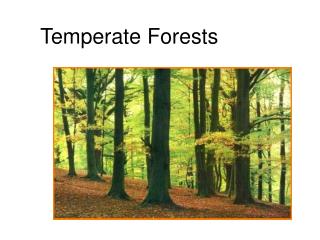
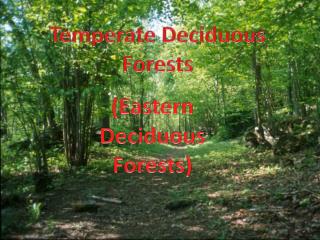
Temperate forests, found between the tropics and polar regions, experience four distinct seasons with 30 to 60 inches of rainfall annually. Summers hover around 70°F and winters average 32°F, featuring deciduous trees that shed leaves in autumn and rebloom in spring. These forests are home to diverse wildlife, including grey squirrels, white-tail deer, and various bird species, as well as essential natural resources like timber and clean air. However, human activities such as deforestation and pollution pose significant environmental concerns.

Temperate Forests
E N D
Presentation Transcript
Temperate Forests Jessica Walsh & Melissa Mayberry
Location • Between tropics and polar regions • 30 to 60 inches of rain yearly Four Seasons . • Summers around 70° F • begin in June and end in August • Deciduous trees loose leaves in Autumn • Winters around 32° F • begin in December • snows • Deciduous trees re-grow leaves in Spring
Where in the World? • Most of Europe • Japan • North East China • Eastern United States • South East Australia • New Zealand
Producers • Ground Layer – mosses and grasses • Understory – shrubs and young trees Lady Fern Trillium Carpet Moss Grass Blackberry Bush Huckleberry Bush Wild Raspberries
Producers (cont.) • Canopy – tall, broad leaved trees Oak Hickory Walnut Maple Beech Birch
Consumers • Primary • Secondary, tertiary, etc. Grey Squirrel Wood Mouse Song Birds White-Tail Deer Red Fox Bears Wolves Cougar
Food Chain Owl (tertiary consumer) Ex. spotted owl Snake (secondary consumer) Turkey vulture (scavenger) chipmunk (primary consumer) oak tree (producer)
Natural Resources • Wood from trees • Houses • Ships • Furniture • Paper • Soil is good for farming • Some plants used in medicine • Clean air & water
Environmental Concerns • Humans are cutting down trees for timber • Destroying the homes of animals • Human development and agriculture • Using the soil for farming • Soil then looses its nutrients • Acid rain • Caused by air pollution • Kills plants over time • Global warming • Change rain patterns • Lessen snowfall in winter
Endangered Species • American Hart’s tongue fern • Cannot grow without moisture from snow cover • Only grows by limestone deposits • Red Wolf • Hunted nearly to extinction • Remaining 20 bread in captivity • Currently around 100 in the wild • Grey wolves are also endangered in these areas
References • http://www.blueplanetbiomes.org/deciduous_forest.htm • http://www.ucmp.berkeley.edu/glossary/gloss5/biome/forests.html#temperate • http://www.globio.org/glossopedia/article.aspx?art_id=3 • http://www.world-builders.org/lessons/less/biomes/rainforest/temp_rain/tempweb.html • http://www.marietta.edu/~biol/biomes/tempded.htm • http://www.defenders.org/wildlife_and_habitat/wildlife/red_wolf.php# • http://www.globio.org/glossopedia/article.aspx?art_id=3 • http://www.ri.net/schools/West_Warwick/manateeproject/Temperateforest/Plants.htm • http://www.barrameda.com.ar/ecology/temperate-forest.htm • http://www.marietta.edu/~biol/biomes/tempded.htm