
Computational Complexity
E N D
Presentation Transcript
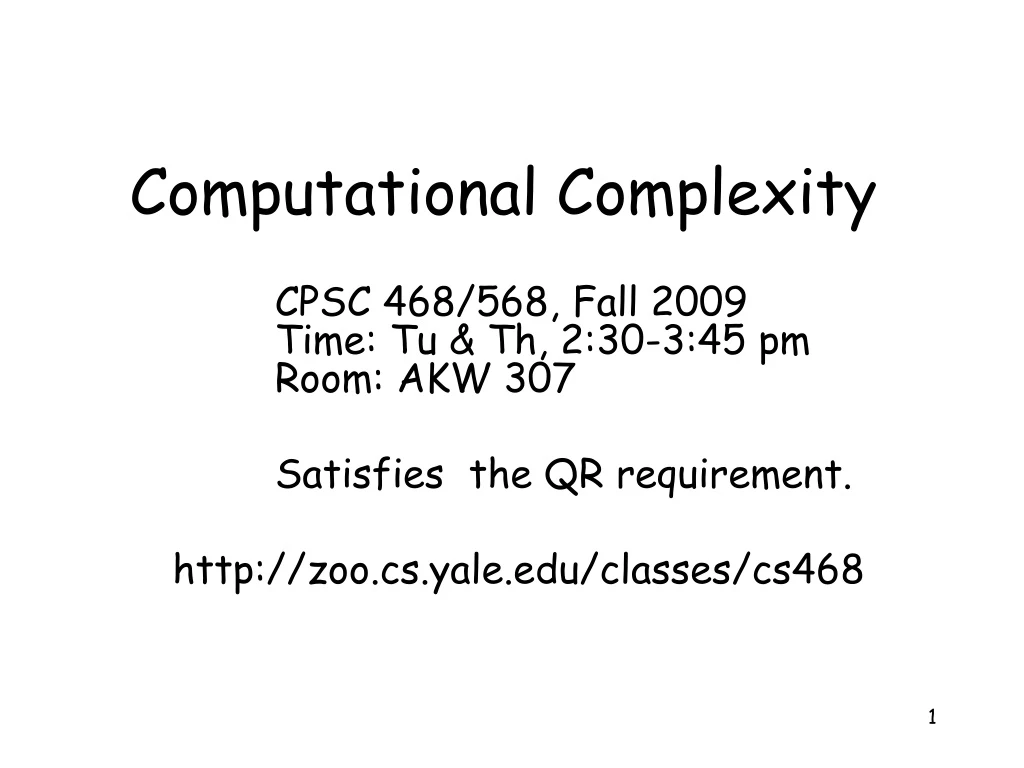
Computational Complexity CPSC 468/568, Fall 2009 Time: Tu & Th, 2:30-3:45 pm Room: AKW 307 Satisfies the QR requirement. http://zoo.cs.yale.edu/classes/cs468
Partial Topic Outline • Complexity classes (P, NP, L, NL, etc.) • Reductions and completeness • The roles of, e.g., • Randomness • Interaction • Approximation • Communication complexity
Requirements Modest reading assignments, mostly in Arora and Barak, Computational Complexity: A Modern Approach, Cambridge Univ. Press, 2009. 6 Written HW Assignments, each worth 10% of the course grade 2 In-Class Exams, each worth 20% of the course grade No final exam during exam week 3
Schedule Sept. 17: First HW Assignment Due Oct. 1: Second HW Assignment Due Oct. 13: Third HW Assignment Due Oct. 15: First In-Class Exam Oct. 23: Fall Semester Drop Date Oct. 29: Fourth HW Assignment Due Nov. 17: Fifth HW Assignment Due Dec. 1: Sixth HW Assignment Due Dec. 3: Second In-Class Exam
Rules and Guidelines • Deadlines are firm. • Late penalty: 5% per day. • Announcements and assignments will be posted on the class webpage (as well as conveyed in class). • No “collaboration” on homeworks unless you are told otherwise. • Pick up your graded homeworks and exams promptly, and tell the TA promptly if one is missing.
Instructor: Joan Feigenbaum Office: AKW 512 Office Hours: Thursdays 11:30 am - 12:30 pm and by appointment Phone: 203-432-6432 Assistant: Judi Paige (judi.paige@yale.edu, 203-436-1267, AKW 507a, 8:30 am – 4:30 pm M-F) Note: Do not send email to Professor Feigenbaum, who suffers from RSI. Contact her through Ms. Paige or the TA.
TA: David Costanzo Office: AKW 301 Email: David.Costanzo@yale.edu Office Hours: TBD
If you’re undecided … Check out: • zoo.cs.yale.edu/classes/cs468/spr07/, …/fall07/, and …/fall08 • www.cs.princeton.edu/theory/complexity/ (draft of textbook by Sanjeev Arora and Boaz Barak of Princeton) • www.cs.berkeley.edu/~luca/cs278-02/ (a complexity-theory course taught by Luca Trevisan at Berkeley in 2002) • www.cs.lth.se/home/Rolf_Karlsson/bk/retro.pdf (“NP-Completeness: A Retrospective,” by Christos Papadimitriou, 1997 International Colloquium on Automata, Languages, and Programming)
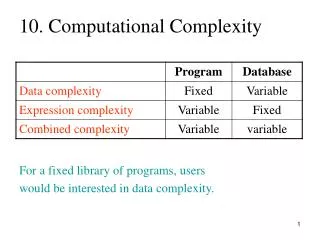
Computational ComplexityThemes • “Easy” vs. “Hard” • Reductions (Equivalence) • Provability • Randomness
Poly-Time Solvable • Nontrivial Example : Matching
Poly-Time Solvable • Nontrivial Example : Matching
Poly-Time Verifiable • Trivial Example : Hamiltonian Cycle
Poly-Time Verifiable • Trivial Ex. : Hamiltonian Cycle
Is it Easier to Verify a Proof than to Find one? • Fundamental Conjecture of Computational Complexity: PNP
Distinctions • Matching: • HC: Fundamentally Different
Reduction of B to A • If A is “Easy”, then B is, too. A B Algorithm “oracle” “black box”
NP-completeness • P-time reduction • Cook’s theorem If B εNP, then B≤ P-timeSAT • HC is NP-complete
Equivalence • NP-complete problems are an equivalence Class under polynomial-time reductions. • 10k’s problems • Diverse fields Math, CS, Engineering, Economics, Physical Sci., Geography, Politics…
NP coNP P
Random poly-time Solvable x εL? YES poly-time Algorithm x r NO x ε{0,1}n r ε{0,1}poly(n)
Probabilistic Classes RP x ε L “yes” w.p. ¾ x L “no” w.p. 1 x ε L “yes” w.p. 1 x L “no” w.p. ¾ coRP (Outdated) Nontrivial Result PRIMES ε ZPP ( = RP ∩ coRP)
Two-sided Error x L “yes” w.p. ¾ x L “no” w.p. ¾ BPP Question to Audience: BPP set not known to be in RP or coRP?
NP coNP RP coRP ZPP P
Interactive Provability x V [PPT, ¢] P yes/no
L εIP • x ε L P: “yes” w.p. ¾ • x L P*: “no” w.p. ¾ Nontrivial Result Interactively Provable Poly-Space Solvable
PSPACE NP coNP RP coRP ZPP P
EXP PSPACE P#P PH iP 2P NP P