The Marketing Mix
80 likes | 224 Vues
This analysis delves into Gears of War 2 (GOW2) within the context of its competitive landscape. It identifies competing products present at the time, discussing similarities and differences among them. The timeline of GOW2’s market emergence and its effects on the original Gears of War are explored, providing implications for Gears of War 3's launch. Additionally, the breakdown of a $60 game revenue illustrates costs, profit divisions, and pricing strategies, including price skimming and its impact on sales. Marketing strategies involving promotion channels and distribution methods are also examined.


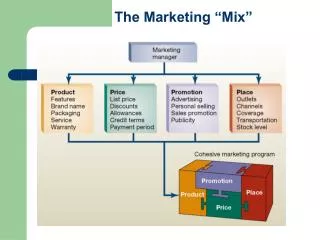
The Marketing Mix
E N D
Presentation Transcript
Product Which other products on the market at the time could said to be GOW2’s competition? How is it similar to/different from these other titles? How quickly did GOW2 eliminate GOW? What might this suggest for GOW 3?
Price • Look at the information on the following slide. • Which entries could reasonably be considered ‘costs of production’? • Which entries could reasonably be considered ‘profit’, and between which institutions is the profit divided?
Where Does the Money Go? ON A $60 GAME OF GEARS: • 25% (aka $15) goes to pay the art and design guys. • 20% ($12) goes to pay the programmers and the engineers. • 20% (also $12) goes to your friendly neighbourhood retailer. EB / GameStop, whoever. • 11.5% ($7) goes to a "Console Owner Fee" – i.e. Company made the console (Sony, MS, Nintendo) • 7% ($4) goes to marketing, and puts Marcus Fenix on MTV. • 5% ($3) goes to "market development" -- paying for cardboard Standees of the Gears Crew and elbowing other games out of the way for shelf space at your local retailer. • 5% ($3) goes to actually manufacturing and packaging the disc. • 5% ($3) is spent paying the agents/companies for the rights to use licensed voice talent • 1.5% (just $1) goes into the publisher's pocket. • 1.5% (also $1) goes into the distributor's pocket. • 0.3% (about 20 cents) goes into corporate costs: management, overhead, lawyers, etc. • 0.05% (less than 3 cents) go into the cost of paying for the Developer's Hardware. Source: Forbes Magazine
Price Skimming • Price skimming is a pricing strategy in which a marketer sets a relatively high price for a product or service at first, then lowers the price over time. • Gears of War 2 prices: • Release [12/11/2008] = $60 • Dropped [03/07/2009] = $39.99 • Current [24/04/2010] = $29.99 You will need to find out how the other two games compare with this...
Place • We have already looked at conventional distribution vs digital distribution • There are no direct sales for Epic Games • All sales are done through third parties • E-Commerce accounts for digital downloads • Dark Corners (which is a complete collection of all previous DLC) retails for c.$20; initial product price = $60. MGS would expect to make at least an additional 33% of the original price through add-ons. • This means they can overspend by up to 1/3 when developing the original product and expect the overspend to be soaked up by add-ons. • This might allow a more extravagant spend on the initial product: it will need to secure a market for later sales.
Promotion • Promotion has four distinct elements: • Advertising – trailers, teasers (short trailers), interviews, ‘making-of’ videos: • Can be on TV • Cinemas • Official Website of Manufacturer • Public Relations – other professional bodies like: • Video Games Conventions (E3, Comic Con) • IGN or other respected websites • Computer Games magazines, reviewers, etc (who often get free copies in advance of general release) • Word of Mouth – includes friends talking offline, but is especially targeted via Xbox Live community • Point of Sale – cut-outs, banners: the stuff you see in-store when you go to buy a game. Also includes promotion by store staff.