Understanding Redox Reactions: Oxidation and Reduction Simplified
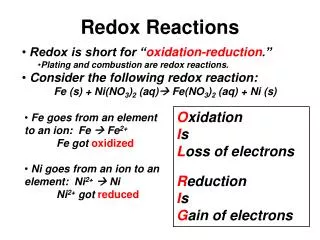
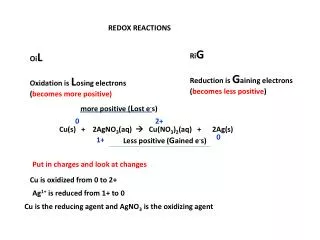
This guide delves into redox reactions, focusing on oxidation and reduction processes. Oxidation involves the removal of electrons from an atom (e.g., Na → Na⁺ + e⁻), while reduction is characterized by the gain of electrons (e.g., Cl₂ + 2e⁻ → 2Cl⁻). Remember the mnemonic "LEO says GER" to differentiate between the two: Loss of Electrons is Oxidation, Gain of Electrons is Reduction. We explore examples like 2K + Br₂ → 2KBr, identifying potassium as the reducing agent (oxidized) and bromine as the oxidizing agent (reduced).

Understanding Redox Reactions: Oxidation and Reduction Simplified
E N D
Presentation Transcript
REDOX REACTIONS PART 2
OXIDATION • The process by which electrons are removed from the atom. Na Na+ + e-
REDUCTION • The process by which any atom or ion gains electrons Cl2 + 2e- 2Cl-
“LEO the Lion says GER” • L=lose • E= electrons • O= oxidation • G=gain • E=electrons • R=reduction
Example • Chemical Equation: 2K + Br2 2KBr • Net ionic equation: 2K + Br2 2K+ + 2Br- • The potassium has lost electrons (became more positive)- OXIDIZED • The bromine had gained electrons (became more negative)- REDUCED
Oxidizing Agent • The substance that oxidizes another substance by accepting the electrons. • This is the substance that is reduced in the reaction.
Reducing Agent • The substance that reduces another substance by losing electrons. • A reducing agent supplies electrons to the substance getting reduced, therefore it is oxidized.
Example Chemical Equation: 2K + Br2 2KBr Potassium is oxidized, therefore it is the regucing agent. Bromine is reduced, therefore it is the oxidizing agent.
Oxidation Number If a substance is oxidized, its oxidation number increases. If the substance is reduced, its oxidation number decreases.