Linked Lists
A singly linked list is a fundamental data structure composed of a sequence of nodes, where each node contains an element and a reference to the next node. This guide explores the Node class, including methods for creating nodes, accessing, and modifying elements, as well as inserting and removing nodes at both the head and tail of the list. Additionally, it discusses how to implement stacks and queues using singly linked lists, highlighting the efficiency of operations and memory usage. This foundational knowledge is essential for understanding more complex data structures and algorithms.

Linked Lists
E N D
Presentation Transcript
Linked Lists Linked Lists
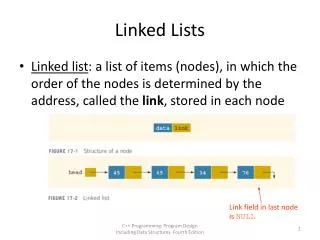
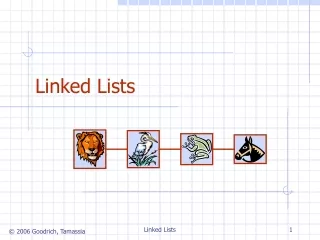
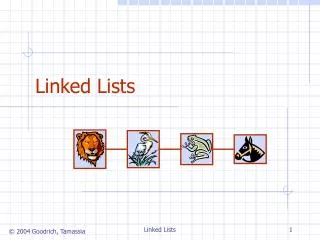
Singly Linked List (§ 4.4.1) • A singly linked list is a concrete data structure consisting of a sequence of nodes • Each node stores • element • link to the next node next node elem A B C D Linked Lists
The Node Class for List Nodes public class Node { // Instance variables: private Object element; private Node next; /** Creates a node with null references to its element and next node. */ public Node() { this(null, null); } /** Creates a node with the given element and next node. */ public Node(Object e, Node n) { element = e; next = n; } // Accessor methods: public Object getElement() { return element; } public Node getNext() { return next; } // Modifier methods: public void setElement(Object newElem) { element = newElem; } public void setNext(Node newNext) { next = newNext; } } Linked Lists
Allocate a new node Insert new element Have new node point to old head Update head to point to new node Inserting at the Head Linked Lists
Removing at the Head • Update head to point to next node in the list • Allow garbage collector to reclaim the former first node Linked Lists
Inserting at the Tail • Allocate a new node • Insert new element • Have new node point to null • Have old last node point to new node • Update tail to point to new node Linked Lists
Removing at the Tail • Removing at the tail of a singly linked list is not efficient! • There is no constant-time way to update the tail to point to the previous node Linked Lists
Stack with a Singly Linked List • We can implement a stack with a singly linked list • The top element is stored at the first node of the list • The space used is O(n) and each operation of the Stack ADT takes O(1) time nodes t elements Linked Lists
Queue with a Singly Linked List • We can implement a queue with a singly linked list • The front element is stored at the first node • The rear element is stored at the last node • The space used is O(n) and each operation of the Queue ADT takes O(1) time r nodes f elements Linked Lists