Download
1 / 12
120 likes | 227 Vues
This presentation by Cheng-Han Tsai discusses the need for personalized e-learning platforms that go beyond delivering uniform educational resources. It outlines methodologies such as collaborative filtering, cosine similarity, and various recommendation algorithms to create an adaptive learning environment. The proposed system leverages offline and online learner models and content modeling using the open-source Nutch engine to generate real-time recommendations. The integration of diverse approaches aims to enhance the educational experience by providing tailored learning objects for users.

E N D
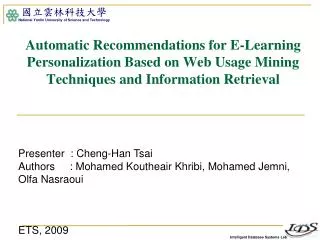
Automatic Recommendations for E-Learning Personalization Based on Web Usage Mining Techniques and Information Retrieval Presenter : Cheng-Han Tsai Authors : Mohamed KoutheairKhribi, Mohamed Jemni, OlfaNasraoui ETS, 2009
Outlines • Motivation • Objectives • Methodology • Experiments • Conclusions • Comments
Motivation • Most e-learning platforms are still delivering the sameeducational resources to learners • Most e-learning platforms have not been personalized
Objectives • To build an automatic recommendations in e-learning platforms
Methodology offline Learner model Content models CF&Cosine Similarity&Apriori algorithm&Association Rules&Confidence CBF & LOM&Inverted Index online CF + KNN&CBF + TF-IDF
Methodology Learner model Confidence
Methodology Content model Using the open source search engine Nutch in content model-ing followed by CBF Automatically generates invert-ed index
Conclusions The proposed approaches can provide adaptive learning objects to different users The recommendation system can compute against massive repository of educational resources in "real time".
Comments • Advantages • Integration of many approaches in this paper • Applications • IR