Sidewinder: A Predictive Data Forwarding Protocol for Mobile Wireless Sensor Networks
This paper introduces Sidewinder, a novel data forwarding protocol designed for mobile wireless sensor networks in unpredictable environments such as flooding scenarios. Traditional fixed-location sensors struggle to map entire flood regions accurately, whereas mobile sensors can track dynamic flood areas. Sidewinder utilizes Sequential Monte Carlo methods for effective sink location prediction, enabling efficient routing of data packets over multiple hops. The protocol adapts to mobility through limited flooding and provides real-time monitoring of flood dynamics, significantly enhancing data delivery performance in challenging conditions.

Sidewinder: A Predictive Data Forwarding Protocol for Mobile Wireless Sensor Networks
E N D
Presentation Transcript
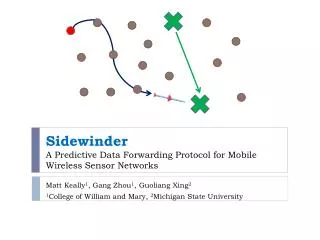
SidewinderA Predictive Data Forwarding Protocol for Mobile Wireless Sensor Networks Matt Keally1, Gang Zhou1, Guoliang Xing2 1College of William and Mary, 2Michigan State University
Overview • Motivation • Contributions • Related Work • Design • Evaluation • Conclusion
Storm Surge and Inundation Monitoring • Models and simulation available to predict storm surge from hurricanes • Wish to verify that models are correct using real data • Fixed location sensors cannot provide a contour map of entire flood region
Buoyant Sensor Network • Mobile nodes can track an unpredictable flood area • Nodes provide real-time speed and movement of flood zone • Localization provided through GPS • Flooding data from nodes routed over multiple hops to mobile sinks • Sinks transmit data to shore via long range radio • Routing data from source to sink with volatile topology changes
Contributions • Sidewinder: A data forwarding protocol for mobile environments • Data packets “home in” on the sink with each hop • Use of Sequential Monte Carlo (SMC) methods to predict sink location • Sink prediction is refined and aggregated with each hop • SMC is scaled to function in computation and bandwidth restricted wireless sensor networks • nesC implementation and evaluation in TOSSIM • Random and group mobility models
Related Work • Path Discovery (AODV, MultiHopLQI) • Construction of end to end routing path • Paths break quickly in dynamic environments • Neighbor Tables (GPSR, GF, ExOR, DREAM) • Nodes track neighbors through beaconing • Constant beaconing is required when nodes are highly mobile • Zone-Based (IGF, BLR) • Nodes closer to the sink compete to forward data • Evaluation shows proximity is not enough
Main Idea • Infrequent flooding of sink location and movement • Nodes closer to the sink are provided with more frequent updates • Source and forwarding nodes predict current sink location • Prediction aggregated over each hop Source Estimated Sink Location Actual Sink Location
Sidewinder Design • Mobility Monitor: Track individual and group mobility • Adaptive Update: Sink provides network with its location and velocity • SMC Prediction: Data forwarding with aggregated sink prediction • Limited Flooding: Forwarders within two hops of the sink flood data
Mobility Monitor • Derive group and individual node random velocities • Used in sink location prediction and data forwarding A B S D C
Adaptive Update • Sink node transmits location and mobility • Time and space adaptivity to save bandwidth and energy B Sink (Last Update) A Time Update: Space Update: Sink Sink (Next Update)
Sequential Monte Carlo Prediction • Data routed from source to sink using aggregated sink location predictions • SMC: Iteratively update estimate of sink location • Sink location estimate is a distribution of possible sink locations • Four Phases: • Initialization • Prediction • Filtering • Resampling
Initialization • Source and forwarding nodes predict sink location • Use last known sink location from Adaptive Update Source/Forwarding node Estimated Sink Location Center Last Known Sink Location Estimated Sink Location Area • Refine (reduce) area over multiple hops with better prediction
Initialization • Source generates sink location distribution with N random points • 60 degree zone-based forwarding • Adaptation to WSN: Q sectors instead of N points, Q << N Source F B Sector 3: 2 points C Estimated Sink Location Area Sector 2: 4 points Sector 1: 2 points Sector 0: 0 points
Prediction and Filtering • A forwarding node may have better sink location information than the last hop • Node F uses its own estimated sink area to refine the sink location distribution Source F F: Estimated Sink Location Area Source: Estimated Sink Location Area
Prediction and Filtering • Forwarding node reconstructs last hop’s sectors • Possible sink positions placed in estimated sink area • “Impossible” sink positions are left out Source F Sector 3: 2 points Sector 2: 4 points Sector 1: 2 points Sector 0: 0 points
Resampling • Replace excluded sink positions from Filtering: ensure N • Generate new sectors and forward to next hop Sector 3: 1 point F Sector 2: 3 points Sector 1: 4 points Sector 0: 0 points • Use Limited Flooding when two hops from the sink
Experimental Setup • Sidewinder implementation in nesC, TinyOS-2.x • Compared with GF and Zone-Based “Beaconless GF” • TOSSIM with added mobility models • Random Waypoint without pause time (215m x 215 m) • Reference Point Group (2000m x 2000m) • 500 nodes, ~20 neighbors per node • 3 sources and one sink chosen at random, ~6 hops • Vary node speed from 0m/s to 20m/s • Plot with 90% confidence intervals for 100 runs
Evaluation: Packet Delivery Ratio • Sidewinder outperforms GF and BGF when nodes are mobile • SMC Prediction allows for low loss under excessive topology changes
Evaluation: Packet Delivery Ratio • GF neighbor table hurts random mobility case
Evaluation: Packet Delivery Ratio • BGF (Zone-Based) is not enough to account for mobility; prediction is needed
Evaluation: Time Delay • Sidewinder and BGF experience low and constant time delay (<1s)
Evaluation: Time Delay • GF experiences routing loops, especially with group mobility
Evaluation: Energy Consumption • Sidewinder has constant energy consumption with increasing mobility
Evaluation: Energy Consumption • Sidewinder and BGF experience similar energy consumption
Evaluation: Energy Consumption • GF has high energy consumption due to longer paths and beaconing
Conclusion • Traditional routing protocols fail in highly mobile environments • Sidewinder integrates SMC prediction into data forwarding to accurately estimate sink location • Prediction is aggregated over multiple hops • Sector-based approach preserves sink location distribution over multiple hops with low overhead • Evaluation shows high packet delivery ratio, low time delay and low energy consumption compared with traditional approaches
The End • Thanks to the reviewers for their helpful comments