Enhancing Deniable Authentication Protocol through Diffie-Hellman Algorithm
This paper presents an improved deniable authentication protocol utilizing the Diffie-Hellman key exchange, enhancing security while addressing inefficiencies in previous schemes. The introduction outlines the concept of deniable authentication, highlighting advantages for electronic voting systems. We analyze related works, and then propose an improved algorithm ensuring mutual authentication while maintaining deniability against third-party claims. Our security analysis confirms that malicious users cannot exploit the protocol, thus establishing a secure communication method. The paper concludes with significant insights and references for further exploration.


Enhancing Deniable Authentication Protocol through Diffie-Hellman Algorithm
E N D
Presentation Transcript
"It's not that I'm so smart, it's just that I stay with problems longer." -- Albert Einstein
IMPROVEMENT INDENIALBE AUTHENTICATION PROTOCOL USING DIFFIE-HELLMAN ALGORITHM BY – SUMIT TIWARI 2005H112056
Outline • Introduction • Related Works • Prerequisites • Fan et al. protocol • Proposed Deniable Authentication Scheme • Security Analysis • Conclusion • References
INTRODUCTION • Deniable Authentication Protocol • The Receiver can verify source of the message. • The Receiver cannot prove the source of the message to the third party. • Used in Electronic Voting Systems.
Related Works • Aumann and Rabin also proposed deniable authentication protocol based on factoring in 1998. • Den et al. proposed two deniable authentication protocols based on the factoring and the discrete logarithm problem respectively. • All of above protocol need public directory, which is trusted by the sender and the receiver.
Fan Et al. Scheme • Deniable Authentication Protocol using Diffie-Hellman Key Distribution. • Problem – • An Intruder can convince Sender to initiate protocol with him.
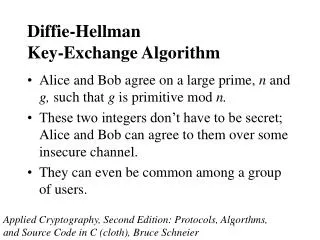
Prerequisites • Diffie-Hellman key exchange algorithm. • Need • q Prime number & a < q and a be the primitive root of q (Global) • Both A and B Select XA and XB (privately)< q • Calculates YA = a XA mod q & YB = a XB mod q • Key k = (YA ) XB mod q= (YB ) XA mod q
Review of the Fan et al.’s scheme • Both A (Sender) and B (Receiver) selects i and j large random number.
Improvement at Fan et al. Scheme • Preliminaries • A & B must take certificate from Certificate Authority before negotiation. Cert(A) and Cert(B) • A and B know the public number g and P where P is a large prime number and g is the primitive root of P. • YA = g XA mod P • YB = g XB mod P
Proposed Algorithm 1. A select large random integer tA and calculates I = (YB ) XAtA mod P = (g) XBXAtA mod P rA = (YA ) tA mod P SA = tA + (XA -1) * H(I)mod(P-1) I, SA ,rA ,Cert(A) are send to B
Proposed Algorithm 2. B verifies A’s Public key according to Cert(A).B checks whether YA SA = rA*( g) H(I) mod P B convinced that I is indeed valid partial session key.
Proposed Algorithm 3.B selects the large random number tB J = (YA ) XBtB mod P = (g) XBXAtB mod P rB = (YB ) tB mod P = (g) XBtB mod P k = (I) tB mod P = (g) XAtAXBtB mod P SB = tB + (XB -1) * H(J || k)mod(P-1)
Proposed Algorithm 4.After receiving the transmitted data A first verifies B’s public key according to Cert(B) and then computes K’ = (J) tA mod P = (g) XAtAXBtB mod P after that A checks whether YB SB = rB*( g) H(J || K’) mod P 5. When A wants to send the message M to B A computes D = H (K’,M) and sends M and D to B.
Proposed Algorithm • After getting M & D , B checks weather H(k,M) = D. If no errors then comparison will be successful and k = k’.
Security Analyses • C can try to get A’s or B’s secret key from (I, rA, SA ) or (J, rB, SB). • C wants to forge the valid data send from A/B. • C cannot fool innocent user A. He does not know B’s Secret key. He cannot compute (J, rB, SB) & k. • B cannot prove the source of delivered message sent from A to the third party C.
Achieved Properties • The Proposed Protocol is deniable • Mutual Authentication is confirmed. • The Algorithm proposed provided efficiency.
Conclusion • Fan et al. proposed a deniable authentication protocol. • It lacks efficiency and malacious user can play tricks. • The Proposed protocol is deniable, secure and efficient.
Queries "Not every thing that can be counted counts and not everything that counts can be counted."
References • An Improvement on a deniable authentication protocol – Ya–Fan Chanf, Chin-Chen Chang. • Deniable Authentication Protocols based on diffie hellman key exchange – Fan L.,Xu ,C.-x.