
Light Collection and Photon Detectors in Particle Detectors
E N D
Presentation Transcript
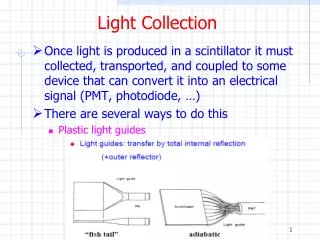
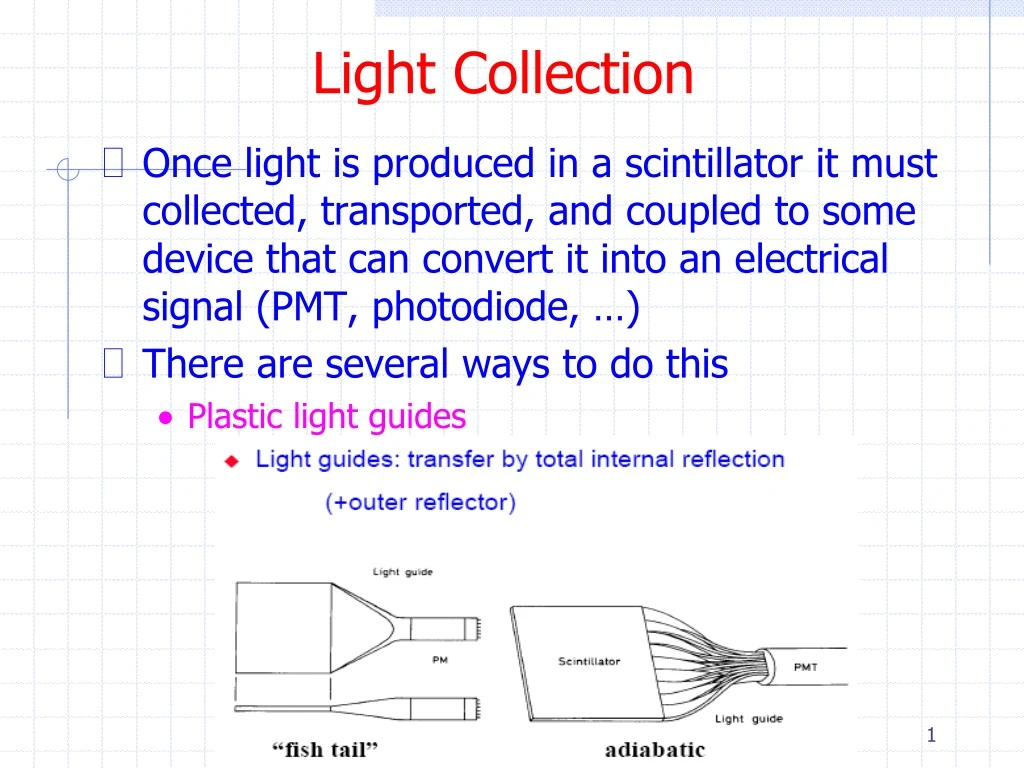
Light Collection • Once light is produced in a scintillator it must collected, transported, and coupled to some device that can convert it into an electrical signal (PMT, photodiode, …) • There are several ways to do this • Plastic light guides
Light Guides Isotropic light emission
Light Guides • Even for total internal reflection over all angles, if Dx1 >> Dx2 there will be substantial light loss
Wavelength Shifters • Liouville’s theorem can be beat by decreasing the energy of the photons • Wavelength shifter can be used • To collect light from large areas and transport it to a small PMT area • To better match the PMT sensitivity • To bend the light path
Wavelength Shifters • Wavelength shifting bars • Wavelength shifting fibers
ATLAS Tile Calorimeter ATLAS Tile Calorimeter
ATLAS Tile Calorimeter ATLAS Tile Calorimeter
ATLAS Tile Calorimeter ATLAS Tile Calorimeter
Outer Reflectors • Usually the scintillator and light guide are wrapped/enclosed with an outer reflector • Measurements at 440 nm,
Photon Detectors • Once light is produced in a scintillator we need to convert it into an electronic signal • Vacuum based (this lecture) • Photomultiplier tubes (PMTs) • Semiconductor (later lectures) • Photodiodes, APDs, SSPM, CCDs, VLPCs, … • Hybrid • Vacuum+semiconductor • Gas based (TEA, TMAE) • For Cerenkov detectors
Photon Detectors • We’ll be interested mainly in the visible region today
Photon Detectors • The main principle used is the photoelectric effect which converts photons into electrons (photoelectrons) • Important quantities characterizing the sensitivity are the quantum efficiency and radiant sensitivity
Windows • Borosilicate typical
Photocathodes • The important process in the photocathode is the photoelectric effect • Photons are absorbed and impart energy to electrons • Electrons diffuse through the material losing energy • Electrons reaching the surface with sufficient energy (> W) escape • Alkalai metals have a low work function • e.g. bialkali is SbKCs
Photocathodes • QE of bialkali PMT’s
Photocathodes • As you can see from the graph, the maximum QE is about 25% for current bialkali • Photoelectron emission is isotropic • 50% to first dynode, 50% to window • Transmission losses • Bialkali photocathodes are ~40% transmissive • 0.5 x 0.4 ~ 0.2
Energy Resolution • In gamma ray spectroscopy and other applications, the energy resolution is an important quantity • One contribution to the energy resolution is the statistical variance of the produced signal quanta • In the case of a PMT, the energy resolution is determined by the number of photoelectrons arriving at the first dynode
Dynode Structure • The dynode structure multiplies the number of electrons • Process is similar to photocathodes but here the incident radiation is electrons
Dynode Structure • There are a variety of dynode structures including some that are position sensitive
Dynode Structure • d of 4-6 for most dynode materials • And typically there are 10-14 stages (dynodes)
Dynode Structure • Typical instantaneous current? • Assume 103 photons at the photocathode • Then there are 2.5x10² electrons at the first dynode • Then there are 2.5x10⁸ electrons at the anode • And collected in 5ns gives a peak current of 2.5x108 x 1.6 x 10-19 / 5 x 10-9 = 8 mA • Of course the average current is much smaller
Dark Current • A small amount of current flows in the PMT even in completely dark state • Causes of dark current include • Thermionic emission from photocathode and dynodes • Leakage current (ohmic leakage) between anode and other electrodes • Photocurrent produced by scintillation from glass or electrode supports • Field emission current • Cosmic rays, radioactivity in glass envelope, radioactivity (gamma) from surroundings (cement) • Dark current increases with increasing supply voltage
PMT Gain and HV Supply • Typical gain versus high voltage curve • Rule of thumb is DV=100 gives DG=2
PMT Base • A voltage divider network is used to supply voltage to the dynodes • Typical supply voltage is 2kV • The manufacturer usually supplies a circuit diagram and often sells the accompanying base
PMT Base • The HV supply must be capable of providing a DC current (to the divider network) as well as average and peak signal currents • Typical signal current ~ 20 mA • Typical average current ~ 20 mA • It is possible that at high rates that the HV supply cannot provide enough current to the last dynodes and hence the PMT voltage will “sag” • Additional charge can be supplied by using capacitors or transistors
PMT Base • Using capacitors or transistors to supply charge
Magnetic Shielding • DV between the dynodes is ~100-200V • Low energy electrons traveling from dynode to dynode can be affected by small magnetic fields (e.g. earth B ~ 0.5 G) • Effect is largest for head-on type PMT’s when the magnetic field is perpendicular to the tube axis • A magnetic shield (e.g. mu-metal) is used to reduce gain changes from magnetic fields
PMT’s • There are a wide range of PMT types and sizes • From Hamamatsu catalog
Light Guides • Liouville’s theorem • Phase space is conserved • Phase space density of photons cannot be increased • You can’t make a tapered light guide without losing light
Light Guides • So for a maximum output angle a2 the input angle a1 is limited • Even for complete TIR, if Dx1 >> Dx2 there will be substantial light loss
Light Guides • Transport light by total internal reflection (TIR) • The air gap between scintillator and wrapping is important • Maximum angle for TIR at light guide output is • For light that does escape the light guide it can be recaptured using specular (Al foil) or diffuse (Tyvek) reflection
Light Guides • An example • Many people use Tyvek but one should do studies for each specific application
Light Guides • There will be some light loss even in the case of equal dimensions
Wavelength Shifter • Liouville’s theorem • Phase space is conserved • Phase space density of photons cannot be increased • You can’t make a tapered light guide without losing light • One can get around Liouville’s theorem by using a wavelength shifter such as BBQ • Light is absorbed and subsequently emitted (isotropically) at a longer wavelength