Chapter 2 – 1956 to 1964
This chapter explores the significant advancements in computing from 1956 to 1964, focusing on IBM's breakthrough innovations such as core memory and the IBM 1130. It discusses the shift from vacuum tubes to transistors, the development of key architectures, and the emergence of influential systems like Air Force SAGE. Key players like UNIVAC, Honeywell, and GE are examined to showcase their contributions and failures in the computing landscape. This era marked IBM's dominance and the competitive nature of the industry, leading to revolutionary changes in data processing and storage.

Chapter 2 – 1956 to 1964
E N D
Presentation Transcript
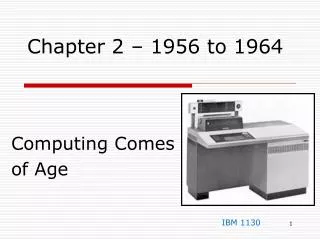
Chapter 2 – 1956 to 1964 Computing Comes of Age IBM 1130
Introduction • Clerks in offices performed many “busy” tasks- Comptometer (Pg.48) • Common Problem: Needed to store/ retrieve large amounts of data- quickly and easily
Core Memory – a radical innovation • Small, donut shaped materials threaded together with fine wires • See Description- Pg. 49 • Hysteresis – from Germany after WWII • Advantages • Small – non-volatile • Random Access • Began to install in existing computers
Core Development • German fire-control systems • Aiken’s Mark IV, 1952 - An Wang • ENIAC, 1952 – Burroughs Corp, 2D • Whirlwind, 1952 – Jay Forrester, 3D • Made it the “fastest”
Air Force SAGE • Semi-Automatic Ground Environment • Early called “Whirlwind II” – similarity • Core Memory 8,192 – 32-bit words • 55,000 vacuum tubes per system • Radar+Aircraft+Telephone+Radio+Ships • To detect & identify enemy aircraft • IBM won contract • Delivered Prototype 1955; 30 more • Each system = 2 identical computers
IBM and SAGE 650 tons: 60,000 tubes, most expensive computer • ½ Billion in revenue for IBM • Began producing own core • 1956: IBM passed UNIVAC in Installations of large systems
In the Meantime….. • While IBM and UNIVAC were leading, others did get in the game • Honeywell • General Electric (GE) • RCA
Honeywell • Raytheon failed to deliver late 1940’s government bid • Joined with Honeywell, 1955 • 1957- Datamatic 1000 • Obsolete • Used Tubes, not transistors • Withdrew; re-entered in 1960’s
GE • 1955- leading electronics firm • $3 billion in sales • 200,000 employees • 1953- OARAC- USAF • Sr. Management decided not to market • Why? IBM was GE’s largest customer of vacuum tubes
GE (continued) • Late 1950’s –ERMA • Electronic Recording Machine Accounting • “1-time project”; transistors + MICR • 1958 - Bank of America & Ronald Reagan unveiling • Research excellent but Mgmt. never committed to computer industry • 1970- sold to Honeywell- $200 million
RCA • $940 million sales; 98,000 employees • BIZMAC, 1955 (Arnold Spielberg, engineer) • Specialized architecture • Several Hundred tape drives • Specialized processors; sort/ search • Failure- behind improvements (tube to transistors) • Another specializedfailure: UNIVAC File
Architecture -- Read Pg. 58-64 • By end of 1960, approx. 6,000 G.P. computers installed in the U.S. • Word Length: Prior to core memories, fetch 1 Bit • 7-12 decimal digits; 30-50 bits • Long words costly & complex • Soon various lengths; • Variable vs. Fixed • 1954: IBM 704-36 bit word length
Architecture Cont. • Registers: Sets of circuits- 1950’s • Accumulator; program counter; index register • 1956 – British, 7 GP registers, 1 PC • Addresses • Single address instructions heavily used • Then 0, 2, & 3 address schemes • Stack architecture
Architecture Cont. • I/O Channels • UNIVAC innovations • Buffer: to help slow I/O • Interrupt: I/O when necessary • Channel: separate processor for I/O • “Becoming” 2- processor system • I/O Channel became defining characteristic of mainframe • Expensive but necessary
Architecture Cont. • Floating Point Arithmetic • Hardware (expensive) vs. Software (slow) • Scientific vs. Commercial • 1st Computers in 1940’s had FP Hardware (Zuse, Bell Labs) • Co-Processors; incorporated into the 486 chip
Transistor • Bell Labs- early 1950’s • Regulated Monopoly, telephone only • Released transistor information(small fee) • Philco-surface barrier transistor • Mass produced & reliable • Leader • SOLO: 1st general purpose, transistorized computer in U.S. (for NSA)- 1956 to 1958
Transistor (cont.) • TRANSAC; S-2000 (1960) • UNIVAC- Solid State 80 • Began Second Generation • 1962- Ford bought , Philco out of computer business • ** Second Generation • 1962- Ford bought Philco • Dropped computer business
Inventors of Transistor Shockley (seated), Bardeen (glasses), Brattain, in 1946 Nobel Prize, 1956
IBM • By 1960, dominated computer industry • 1952- Justice Dept. alleged anti-trust violations in punch card business • 1956- Consent Decree • Must SELL and rent its computers • Third-party vendors bought & leased IBM • Stock soared, in spite of critics • Combination: marketing, manufacturing, & technical innovations
IBM cont’d • Criticism • Took innovations from smaller companies • 704: core, floating-point, FORTRAN was superior to UNIVAC • Sales Force + Manufacturing Techniques + Field Service success
IBM (cont.) • Model 305 Disk • Announced 1956; marketed 1957 • Pack of 50, 24’’ platters • 1200 RPM • 5 M characters- Random Access • “Boundary Layer”- air • RAMAC –Random Access Memory Accounting Machine • 1st United Airlines for reservations • Watson, Jr. “greatest product day…”
IBM’s 7094 (early 1960’s) • 709 tubes 7090 transistors (USAF) • Mainframe: floor, climate • 36-bit word, 150 Kb core • Console – detailed control • Typical Process (p. 73) • Batch Processing • Separate 1401 for printing • $1.6 million - $30,000 month
IBM 1401 & 1620 (Late 1950’s) • Low-end, compact (sold 10K 1401) • Made possible by transistors • Stored program • Core • 1403 Printer • Fastest of its time – 600 lpm
Conclusion • Second Generation • Transition from tubes to transistors • Core Memories • Disks • Business computing applications • IBM success