Download
1 / 45
450 likes | 575 Vues
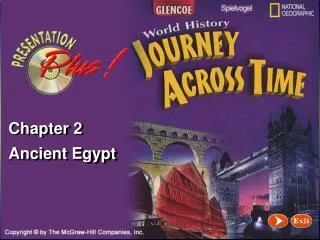
Ancient Egypt emerged around 3000 B.C.E., along the Nile River in North Africa, establishing a rich and distinct civilization. Unlike Mesopotamia, Egypt maintained its unity and power under pharaohs, who wielded vast influence and appointed viziers for governance. The society featured unique cultural practices, trade links with the Mediterranean, and advancements in mathematics, including the concept of a 24-hour day. From daily life to monumental achievements like the pyramids and tombs of pharaohs, ancient Egyptian history is a fascinating journey into a world of innovation and spirituality.

E N D
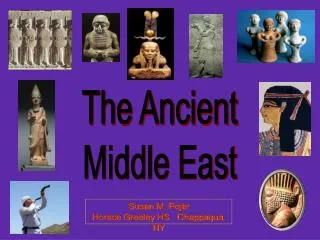
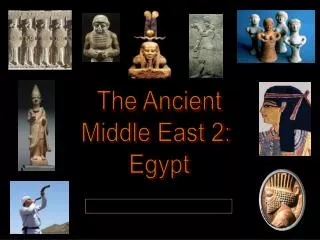
The Ancient Middle East 2: Egypt
2. The Ancient Egyptians
Egyptian Civ • A second center of civilization emerged along the Nile River in N. Africa around 3000 B.C.E. • Egyptian civ. benefited from trade and tech. influence of Mesopotamia, but produced a very different society and culture. • Less open to invasion, Egypt retained a unified state for most of its history. • The pharaoh wielded immense power, and appointed viziers to administer govtthroughout the land.
Menes: Unifier of Upper & Lower Egypt c. 3050 B. C. E. ?
Ancient Egyptian Housing Middle Class Homes Peasant Homes
An Egyptian Woman’s “Must-Haves” Mirror Perfume Wigs
Some Famous Egyptian Pharaohs Tutankhamon1336-1327 B. C.E. Thutmose III1504-1450 B. C. E. Ramses II1279-1212 B. C. E.
Papyrus Paper Scroll Piece Papyrus Plant
Egyptian Math What number is this?
Hieroglyphics “Alphabet” 24 “letters” + 700 phonetic symbols
Egyptian Gods & Goddesses:“The Sacred ‘Trinity’” Osiris Isis Horus
Preparations for the Underworld Priests protected your KA, or soul-spirit
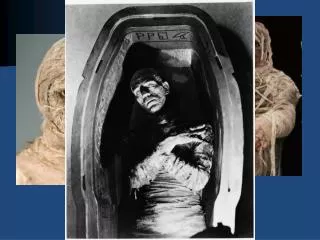
Materials Used in Mummification 1. Linen 6. Natron2. Sawdust 7. Onion3. Lichen 8. Nile Mud4. Beeswax 9. Linen Pads5. Resin 10. Frankinsense
Egyptian Mummies Ramses II1279-1212 B. C. E. Seti I1291-1278 B. C. E. Queen Tiye, wife of Amenhotep II1210-1200 B. C. E.
Journey to the Underworld A boat for the journey is provided for a dead pharaoh in his tomb.
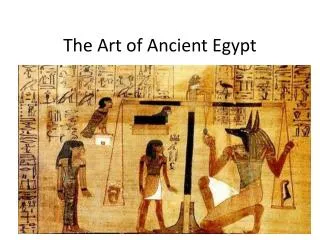
The Final Judgement Anubis Horus Osiris
King Tutankhamon’s Death Mask 1336-1327 B. C. E.
The Valley of the Queens Temple of Queen Hatshepsut 1473-1458 B. C. E.
Ankhenaton: First Monotheist? 1352-1336 B. C. E.
Abu Simbel:Monument to Ramses II 1279-1213 B. C. E.
Legacy of Egyptians • Egyptian mathematics produced the idea of a 24 hour day. • Trade linked Egypt to Mediterranean islands like Crete, south of Greece. • The Greeks studied Egyptian mathematics and art.
Images from: Susan M. PojerHorace Greeley HS Chappaqua, NY, http://www.pptpalooza.net/