Energy-Dependent Transport: Mechanisms of Active Transport in Cell Membranes
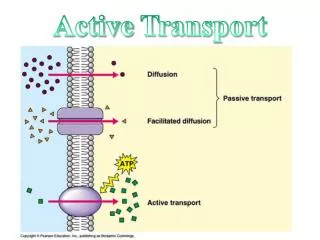
Active transport is essential for moving molecules across cell membranes against their concentration gradients, requiring energy. This process involves carrier proteins and membrane pumps, such as the sodium-potassium pump, which helps maintain cell integrity by regulating ion concentrations. Additionally, endocytosis ("cell eating" and "cell drinking") facilitates the intake of large particles and fluids, respectively. Conversely, exocytosis allows waste materials to exit the cell. Understanding these mechanisms is crucial for grasping cellular functions and homeostasis.

Energy-Dependent Transport: Mechanisms of Active Transport in Cell Membranes
E N D
Presentation Transcript
Active Transport Movement of molecules across the CM
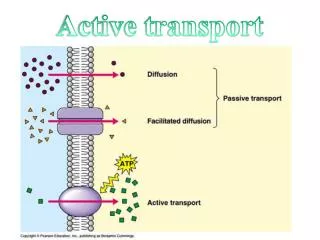
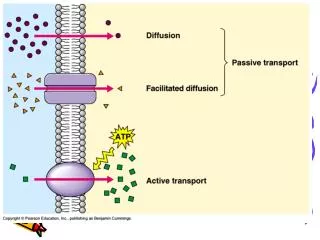
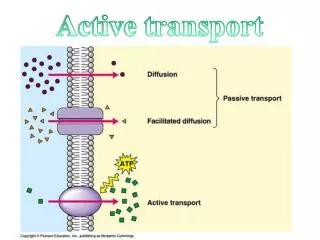
Requires energy! Movement of molecules against conc. gradient move from L H This is gonna be hard work!! high low
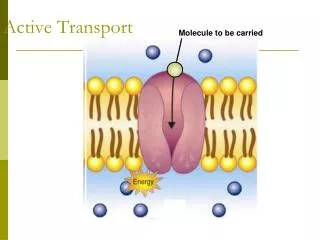
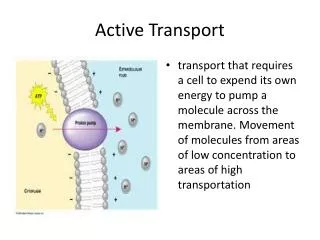
carrier proteins move substances against their concentration gradient 1. Membrane Pumps
Example: Sodium (Na) - Potassium (K) Pump • 3 Na move out of the cell, 2 K move in • Importance – prevents cells from lysis by removing excess Na • Videoclip
2. Endocytosis - “cell eating” • “endo” = inside “cyte” = cell • CM in-folds around food particle, forms vesicle & digests food
2 Types of Endocytosis • a. Phagocytosis • “phag” = eat • bringing large substances into cell • Videoclip • b. Pinocytosis • “pin” = drink • bringing fluid into cell
3. Exocytosis • “exo” = out • Substances leaves cell • membrane surrounding the material fuses with cell membrane