Download
1 / 27
270 likes | 390 Vues
This lesson provides an in-depth exploration of key geometric concepts, including the Segment Addition Postulate and properties of angles. Learners will understand how to find missing variables in line segments and classify angles as acute, right, or obtuse. The lesson includes examples demonstrating how to measure angles and identify congruent angles and angle bisectors. By applying these principles, students will enhance their ability to solve geometric problems and gain confidence in their analytical skills.

E N D
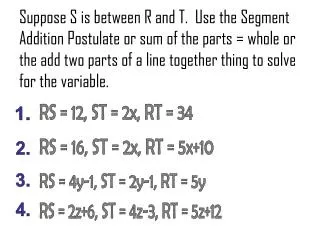
Suppose S is between R and T. Use the Segment Addition Postulate or sum of the parts = whole or the add two parts of a line together thing to solve for the variable. RS = 12, ST = 2x, RT = 34 1. RS = 16, ST = 2x, RT = 5x+10 2. 3. RS = 4y-1, ST = 2y-1, RT = 5y 4. RS = 2z+6, ST = 4z-3, RT = 5z+12
Find the value of the variable and PB, if P is between A and B. A P B AP=-2s, PB=s+8, AB=11 1.
Lesson 1-4 Learners will be able to measure and classify angles, congruent angles, and angle bisectors.
A ray is a part of a line. It has one endpoint and extends indefinitely in one direction. X Y X Y Rays are named stating the endpoint first and then any other point on the ray.
If you choose a point on a line, you make exactly two rays called opposite rays. X Y Z Y X Y Z Name the 2 Rays…
An angle is the intersection of two noncollinear rays at a common endpoint. The common endpoint is called the vertex, and the rays are the sides of the angle.
An angle can be named by a single letter… ex: B A B C Or by three letters: a point on one side, the vertex, and a point on the other side.… ex: ABC
Example 4-1a Name all angles that have B as a vertex. Answer:5, 6, 7, and ABG
Answer: and or are the sides of 5. Example 4-1b Name the sides of 5.
Example 4-1c Write another name for 6. Answer:EBD, FBD, DBF, and DBE are other names for 6.
a. Name all angles that have X as a vertex. b. Name the sides of 3. Answer: c. Write another name for 3. Example 4-1d Answer:1, 2, 3, and RXB or RXN Answer:AXB, AXN, NXA, BXA
There is an interior and an exterior of an angle A Z B C W Where is point Z? W? C?
Angles are measured in degrees. What are degrees? Da sun 1 of a circle 360
A right angle is an angle with a measurement of 90 Logically where is a 45 angle?
There are two other types of angles beside right angles…. 90 < mABC < 180 A C B Obtuse: which have a measurement greater than 90
There are two other types of angles beside right angles…. A mABC < 90 C B Acute: which have a measurement lesser than 90
Answer: is a right angle. Example 4-2a Measure TYV and classify it as right, acute, or obtuse. TYV is marked with a right angle symbol, so measuring is not necessary.
Use a protractor to find that . Answer: > is an obtuse angle. Example 4-2b Measure WYT and classify it as right, acute, or obtuse.
Measure each angle named and classify it as right, acute, or obtuse. a.CZD b.CZE c.DZX Example 4-2d Answer: 150, obtuse Answer: 90, right Answer: 30, acute
Just like with congruent sides we also have congruent angles A C B
A ray or line that divides an angle into two congruent angles is called an angle bisector A C B
A ray or line that divides an angle into two congruent angles is called an angle bisector A C B
INTERIOR DESIGN Wall stickers of standard shapes are often used to provide a stimulating environment for a young child’s room. A five-pointed star sticker is shown with vertices labeled. Find mGBH and mHCI if GBH HCI, mGBH 2x + 5, and mHCI 3x – 10. Example 4-3a
Example 4-3b Given Definition of congruent angles Substitution Add 10 to each side. Subtract 2x from each side.
Since . Answer: Both measure 35. Example 4-3c Use the value of x to find the measure of one angle. Given or 35 Simplify.
SIGNS A railroad crossing sign forms congruent angles. In the figure, WVX ZVY. If mWVX 7a + 13and mZVY 10a – 20, find the actual measurements of WVXandZVY. Answer: Example 4-3d