Oxidation Reduction Reactions
120 likes | 274 Vues
Discover the fundamental concepts of redox reactions in this comprehensive guide. Oxidation refers to the loss of electrons, while reduction refers to the gain of electrons, summarized by the mnemonic "LEO goes GER" (Lose Electrons = Oxidation, Gain Electrons = Reduction). Learn how to identify and assign oxidation numbers in various compounds, and differentiate between oxidizing and reducing agents. Through examples and problem-solving techniques, grasp how to recognize redox reactions in chemical equations, ensuring a clear understanding of their critical role in chemistry.


Oxidation Reduction Reactions
E N D
Presentation Transcript
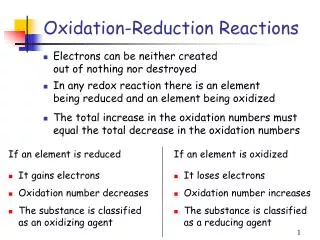
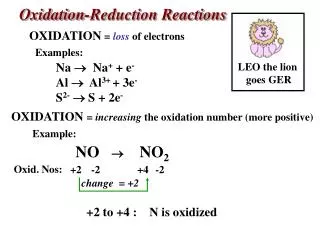
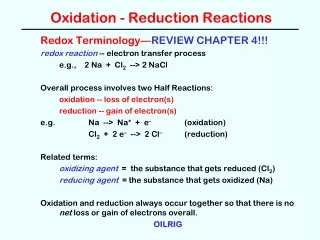
Re-dox Reactions • Oxidation is the loss of electrons • Reduction is a gain of electrons • Leo goes Grr! • Lose Electrons Oxidation • Gain electrons Reduce
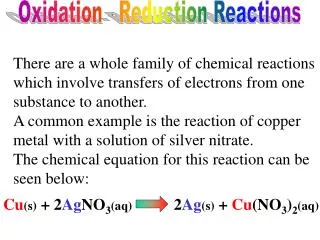
“Redox Reactions” Many reactions involve (or seem to involve) a transfer of electrons. Such reactions always involve both: • Oxidation Loss of electrons Na Na+ + e- • Reduction Gain of electrons Cl + e- Cl-
Determine a Redox Reaction • To determine if what you have is a redox reaction, first rewrite the equation to include the oxidation number for each element • The oxidation number is the charge an element has or appears to have when combining to form compounds
Oxidizing/Reducing Agents • The element that was oxidized is part of the reducing agent. • The element that was reduced is part of the oxidizing agent.
Assigning Oxidation Numbers • All pure elements and homogeneous molecules = 0 • Elements in group IA = +1 • Elements in group IIA = +2 • Ag+, Zn+2, Al+3 (unless it is a pure metal) • In binary compounds the second element = anion charge • Oxygen is almost always = -2 *unless it is O2(g) • Hydrogen is almost always = +1 *unless it is H2(g) • The total charge of a compound is always = 0
A Sample Problem What are the oxidation numbers of the elements in Na2SO4? Na = +1 (times 2 atoms) = +2 O = -2 (times 4 atoms) = -8 +2 + -8 = -6 If the compound must = 0, then S must = +6
Give the oxidation number for: • S in Na2SO3 • Mn in KMnO4 • N in Ca(NO3)2 • C in Na2CO3 • N in NO2- • S in SO4-2 • S in H2S2O7 • Fe in Fe(C2H3O2)2 +4 +7 +5 +4 +3 +6 +6 +2
Ammonia plus Oxygen NH3 + O2 NO + H2O • Is this equation balanced? • No, it does not matter • Step 1: Rewrite the equation with the charges N3-H+3 + O02 N2+O2- + H+2O2-
Ammonia plus Oxygen • Step 2: Determine the changes in the charges of each element N3-H+3 + O02 N2+O2- + H+2O2- • Nitrogen changes from 3- to 2+ • it lost an electron and was oxidized • Oxygen changes from 0 to 2- • it gains electrons and so is reduced
Last Step • Step 3: If there is a species oxidized and one reduced, then it is a redox equation