10.2 MEIOSIS
140 likes | 260 Vues
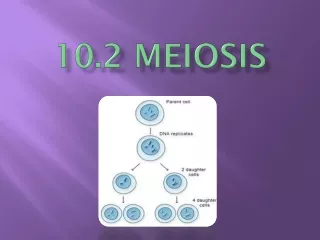
Explore the essential process of meiosis, which is crucial for sexual reproduction and genetic diversity. Meiosis creates haploid gametes—sperm and egg cells—by reducing the chromosome number from diploid (2n) to haploid (n). This process involves two rounds of cell division (PMAT I and II), leading to genetic variation through mechanisms like crossing over. Nondisjunction can result in chromosomal abnormalities, such as Down syndrome. Learn how meiosis ensures that offspring inherit the right chromosome number from their parents.


10.2 MEIOSIS
E N D
Presentation Transcript
10.2 MEIOSIS Martin 2022
GENES, CHROMOSOMES, AND NUMBERS • A. Dipolid and Haploid Cells: • Diploid Cells: cell that have two of each kind of chromosome • 2n • Found in all “body” cells • Haploid Cells: only have 1 of each kind of chromosome • n • Found ONLY IN SEX CELLS (sperm and egg) • Sex cells also known as gametes
GENES, CHROMOSOMES, AND NUMBERS • B. Homologous Chromosomes: • Two chromosomes in each pair of a diploid cell • Each pair has genes for the same trait • Genes arranged in the same order, but may be different in their alleles (dominant or recessive)
GENES, CHROMOSOMES, AND NUMBERS • Why Meiosis?: • Meiosis: a type of cell division that allows gametes (sex cells) to form, so that after fertilization, offspring have the same number of chromosomes as their parents • Sperm: male gametes • Egg: female gametes
GENES, CHROMOSOMES, AND NUMBERS • Meiosis is used to create cells for sexual reproduction: • Male gamete (23) fertilizes female gamete (23) and produces a zygote (offspring with 46 chromosomes) • Remember, this is different from mitosis • Mitosis = 2n 2n • Meiosis = 2n n
THE PHASES OF MEIOSIS • PMAT I, then PMAT II • Has 2 cell divisions that lead to 4 haploid cells • During PROPHASE I • 2 homologous chromosomes pair so tightly that crossing overcan occur • Where non-sister chromatids can break off and exchange genetic information • Can occur at ANY LOCATION on a chromosome, at several locations, and at the same time
THE PHASES OF MEIOSIS • METAPHASE I • Homologous chromosomes line up along the midline/equator as a pair (tetrads) • ANAPHASE I • Homologous chromosomes separate • METAPHASE II • Chromosomes line up independently/randomly along equator • ANAPHASE II • Sister chromatids are separated
MEIOSIS PROVIDES FOR GENETIC VARIATION • This variation can be because of crossing over during metaphase I • Can also be due to genetic recombination • the reassortment of chromosomes and the genetic information they carry by crossing over or independent segregation of homologous chromsomes
NONDISJUNCTION • Sometimes there’s an error in meiosis • Nondisjunction: • The failure of homologous chromsomes to separate during meiosis • Leaves 1 gamete with an extra chromosome, and 1 gamete with 1 missing chromosome (22, 24) • Trisomy 21 = Down Syndrome