Transforming American Cities: Economic and Social Changes in the Late 19th Century
210 likes | 309 Vues
In the late 19th century, American cities underwent significant transformation driven by economic prosperity and social changes. The rise of a new middle class with disposable income led to increased consumerism, as advertisements reflected the growing demand for labor-saving devices and leisure products. Urban centers expanded dramatically, with technological advancements in transportation and communication reshaping lifestyles. By 1900, cities like Atlanta and Chicago became bustling hubs, while suburban neighborhoods emerged, marking a new era of American city life that emphasized consumption, leisure, and social engagement.


Transforming American Cities: Economic and Social Changes in the Late 19th Century
E N D
Presentation Transcript
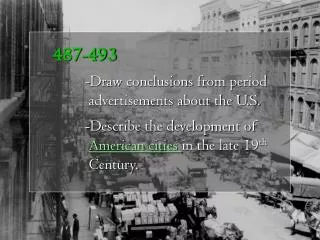
487-493-Draw conclusions from period advertisements about the U.S. -Describe the development of American cities in the late 19th Century.
New American Cities of the 1900s • What conclusions can we draw about life in American cities based on these advertisements? • Middle-class had disposable income to spend, which suggests the economy was booming. • Focus on labor saving devices. • Ads often catered to women. • More consumer goods were manufactured for this new middle class. • Americans had more leisure time. • Many of these goods acted as “economic multipliers”. • Life expectancy increased.
New American Cities of the 1900s • New Cities • Theodore Dreiser called them “Giant Magnets”. • Urban population increased 9-fold, total population tripled between 1860-1920. • By 1900 the industrial core of the U.S. was in the northeast between New York and Chicago. • Of the 1,700 cities that existed in the 1900 census, only 2% existed in the census of 1800.
New American Cities of the 1900s • New Cities • Downtown urban centers grew and pushed out residential areas to the outskirts of cities. • Atlanta’s “Five Points District” grew to dominate the insurance and banking business. • Technological advances such as electric trolleys, lights, and elevated railways or “Els” helped bring this about.
The "Grocery Store" at the turn of the 20th Century – Wash., DC
By 1900, most major cities had begun attempting a reorganization of their clogged transportation systems. Here, in 1897 Philadelphia, horse-drawn wagons and carriages competed with an electric trolley system and pedestrians on a cobblestone street.
New American Cities of the 1900s • New Cities • Residential suburban neighborhoods grew and were populated by this new middle-class. • Short Hills, NJ was 18 miles by RR from NYC. • Designs reflected Catherine Beecher and Harriet Beecher Stowe’s book “American Woman’s Home” (1869) became popular. Stowe Beecher
New American Cities of the 1900s • New Cities • A new middle-class developed and changed lifestyle trends. • New middle-class grew to include new jobs such as salespeople, factory super- visors, managers, civil servants and other “white-collar” types of jobs. • Residence – subdivisions or row houses… …not apartments. • Consumption of goods changed. • Faster meals • 1.4 million telephones • Newspaper tabloids grew with easy to read format, comics.. • Joseph Pulitzer’s New York World • Wm. Randolph Hearst’s New York Journal
New American Cities of the 1900s • New Cities • A new middle-class developed changed lifestyle trends. • Department stores were created to sell to this new middle class • Jordan Marsh • Lord & Taylor • Wanamaker & Brown • Marshall Field
New American Cities of the 1900s • New Cities • Leisure activities grew. • Football grew popular at Harvard and Yale. • Brookline Country Club golf became popular. • Bicycles, parks and skating clubs were common. • Baseball grew to become the leading spectator sport. • Amusement Parks attracted thousands such as George Tilyou’s Steeplechase Park in Brooklyn’s Coney Island.
George Tilyous’s Steeplechase Park in Brooklyn’s Coney Island
New American Cities of the 1900s • New Cities • Entertainment via technology • created silent movies like the • “Great Train Robbery”.
New American Cities of the 1900s • New Cities • Leisure also included an interest in buying sheet music to play songs and buy recorded songs: • Josephine in my Flying Machine - 1910 • Bicycle Built for Two – 1893 • The Good Ole Summertime – 1902 • My Merry Oldsmobile – 1904 • Bill Bailey - 1902