Understanding the Nervous System: Functions and Organization
580 likes | 688 Vues
Explore the body's master communication system – the nervous system, its functions, and organization including the central and peripheral divisions, neurons, and histology. Learn about sensory input, integration, motor output, and more.


Understanding the Nervous System: Functions and Organization
E N D
Presentation Transcript
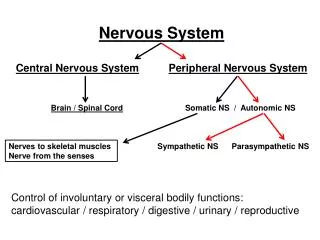
NERVOUS FUNCTIONS • Body’s master controlling and communicating system • Three functions • Sensory input • Gathers information from sensory receptors • Integration • Processes and interprets sensory input • Motor output • Activates effector organs to cause a response
ORGANIZATION Two Principal Parts of the System • Central nervous system (CNS) • Brain and spinal cord • Integrating and command center • Interprets sensory input • Dictates motor responses • Peripheral nervous system (PNS) • Nerves extending from brain and spinal cord • Carry impulses to and from the CNS
PERIPHERAL DIVISIONS Two Functional Subdivisions of the PNS • Sensory division • “afferent division” • Nerve fibers conveying impulses to the CNS • Somatic afferent fibers convey impulses from the skin, muscles, and joints • Visceral afferent fibers convey impulses from visceral organs • Motor division • , “efferent division” • Nerve fibers conveying impulses from the CNS
HISTOLOGY • Nervous system consists mainly of nervous tissue • Highly cellular • e.g., <20% extracellular space in CNS • Two principal cell types • Neurons • Excitable nerve cells that transmit electrical signals • Supporting cells • Smaller cells surrounding and wrapping neurons • “Neuroglia”
NEURONS • Nerve cells • Structural units of nervous system • Billions are present in nervous system • Conduct messages throughout body • Nerve impulses • Extreme longevity • Can function optimally for entire lifetime • Amitotic • Ability to divide is lost in mature cells • Cannot be replaced if destroyed • Some (very few) exceptions • e.g., stem cells present in olfactory epithelium can produce new neurons • Stem cell research shows great promise in repairing damaged neurons • High metabolic rate • Require large amounts of oxygen and glucose
Cell Body Dendrites MyelinSheath Axon Neurons Dendrites of another neuron Axon of anotherneuron
Collins I4 lines • Based on the diagram, what do you think each part does to receive and pass along an impulse toward the brain
Agenda11/3/11 – Day 1 • Take more notes • HW- vocab
NEURONS • Generally large, complex cells • Structures vary, but all neurons have the same basic structure • Cell body • Slender processes extending from cell body • Plasma membrane is site of signaling
NEURON CELL BODY • Most neuron cell bodies are located in the CNS • Protected by bones of skull or vertebral column • Clusters of cell bodies in the CNS are termed “nuclei” • Clusters of cell bodies in the PNS are termed “ganglia”
NEURON CELL BODY • Major biosynthetic (control) center of neuron • Other usual organelles present except CENTRIOLES -Why? • What do centrioles do?
NEURON PROCESSES • Extend from the neuron’s cell body • Two types of neuron processes • Dendrites • Axons
NEURON PROCESSES Typical Dendrite • Short, slender, branching extensions of cell body • Generally hundreds clustering close to cell body • Most cell body organelles also present in dendrites • Main receptive / input regions • Large surface area for receiving signals from other neurons • Convey incoming messages toward cell body
NEURON PROCESSES Typical Axon • Single axon per neuron • The axon forms from the narrowing of the cell body. The region between the large cell body and the axon is the “axon hillock” • Sometimes very short • Sometimes very long • e.g., axons controlling big toe are 3 – 4 feet long
NEURON PROCESSES Typical Axon • Single axon may branch along length • “Axon collaterals” extend from neurons at ~ 90o angles • Usually branches profusely at end • 10,000 or more terminal branches is common • Distal endings termed “axonal terminals”
NEURON PROCESSES Typical Axon • Conducting component of neuron • Generates nerve impulse • Transmits nerve impulses away from cell body towards the axonal terminals
NEURON PROCESSES Typical Axon terminal • Axonal terminals are secretory component of neuron • Sequence of events • Signal reaches terminals • Membranes of vesicles fuse with plasma membrane • Neurotransmitters released • Neurotransmitters interact with either other neurons or effector cells • Excite or inhibit
VocabularyEither in flash card form OR in list • CNS • PNS • Neuron • Stimulus • Afferent division • Efferent division • neuroglia • Amitotic • Dendrite • Cell body • Axon • Axon terminal • Ganglia • Nuclei (in terms of clusters)
Collins I2 lines • What is the difference between the PNS and the CNS?
Agenda11/4/11 -- Day 2 • Remember quiz 11/9 • Take notes • Complete labeling and coloring of neuroglia • HW-complete ALL vocab terms
MYELIN SHEATH • Whitish, fatty covering the axons of many neurons • Protects and electrically insulates fibers • Increases speed of nerve impulse transmission • Some axons and all dendrites are unmyelinated
MYELIN SHEATH • In PNS, Schwann cells Continually wrap around the axon of a neuron • Result is many concentric layers of plasma membrane surrounding the axon • Thickness depends on number of wrappings • Nucleus and most of cytoplasm exist as a bulge external to the myelin sheath
Myelin sheath and schwann cells Node of Ranvier Schwann Cells
MYELIN SHEATH • Adjacent Schwann cells on axon do not touch each other • Gaps in sheath occur at regular intervals • “Nodes of Ranvier” • Axon collaterals can emerge at these nodes
MYELIN SHEATH • In CNS, there are both myelinated and unmyelinated axons • Oligodendrocytes, not Schwann cells, form CNS myelin sheaths • Numerous processes that can coil around numerous (up to 60) axons at once
NEUROGLIA • “Nerve glue” • Six types of small cells associated with neurons • 4 in CNS • 2 in PNS • Several functions • Supportive scaffolding for neurons • Electrical isolation of neurons • Neuron health and growth
CNS NEUROGLIA • Astrocytes • Microglia • Ependymal cells • Oligodendrocytes
CNS NEUROGLIA Astrocytes • Anchor neurons to capillary blood supply • Facilitate nutrient delivery to neurons • (blood astrocyte neuron)
CNS NEUROGLIA Microglia • Small ovoid cells; thorny looking • Transform into macrophage • Phagocytize microorganisms, debris • (Cells of immune system cannot enter the CNS)
CNS NEUROGLIA Oligodendrocytes • Wrap processes tightly around thicker neuron fibers in CNS • Makes “Myelin sheath” • Insulating covering
CNS NEUROGLIA Ependymal Cells • Line central cavities of brain and spinal cord • Many are ciliated • Beating helps circulate cerebrospinal fluid cushioning brain and spinal cord
PNS NEUROGLIA Schwann cells • Surround and form myelin sheaths around larger neurons of PNS • Functionally similar to oligodendrocytes
PNS NEUROGLIA • Satellite cells • Surround cell bodies of PNS ganglia
HW- Vocab Terms • Myelin sheath • Schwann cells • Nodes of ranvier • Oligodendrocytes • Neuroglea • Astrocyte • Microglia • Ependymal cell • Satalite cell
MYELIN SHEATH • White matter • Regions of the brain and spinal cord containing dense collections of myelinated fibers • Gray matter • Regions of the brain and spinal cord containing mostly nerve cell bodies and unmyelinated fibers
NEURON CLASSIFICATION • Structural classification based upon number of processes • Multipolar neurons • Bipolar neurons • Unipolar neurons • Functional classification based upon direction nerve impulse travels • Sensory (afferent) neurons • Motor (efferent) neurons • Interneurons (association neurons)
NEURON CLASSIFICATION Structural Classification • Multipolar neurons • Three or more processes • Most common neuron type in humans • (> 99% of neurons) • Bipolar neurons • Two processes – axon and dendrite • Found only in some special sense organs • e.g., retina of eye • Act as receptor cells • Unipolar neurons • Single short process • Process divides into proximal and distal branches • Distal process often associated with a sensory receptor • “Peripheral process” • Central process enters CNS • Most are sensory neurons in PNS
NEURON CLASSIFICATION Functional Classification • Sensory (afferent) neurons • Transmit impulses toward CNS • From sensory receptors or internal organs • Most are unipolar • Cell bodies are located outside CNS • Motor (efferent) neurons • Carry impulses away from CNS • Toward effector organs • Multipolar • Cell bodies generally located in the CNS • Interneurons • a.k.a., association neurons • Lie between motor and sensory neurons in neural pathways • Shuttle signals through CNS pathways where integration occurs • > 99% of neurons in body • Most are multipolar • Most are confined within the CNS
NEUROPHYSIOLOGY • Neurons are highly irritable • Responsive to stimuli • Response to stimulus is action potential • Electrical impulse carried along length of axon • Always the same regardless of stimulus • The underlying functional feature of the nervous system
ION CHANNELS Plasma membranes contain various ion channels • Passive channels (leakage channels) • Always open • Active channels (gated channels) • Ligand-gated channels • Open when specific chemical binds • Voltage-gated channels • Open and close in response to membrane potential • Mechanically-gated channels • Open in response to physical deformation of receptor • e.g., touch and pressure receptors
MEMBRANE POTENTIALS • A voltage exists across the plasma membrane • Due to separation of oppositely charged ions • Potential difference in a resting membrane is termed its “resting membrane potential” • ~ -70 mV in a resting neuron • Membrane is “polarized”
MEMBRANE POTENTIALS • Neurons use changes in membrane potentials as signals • Used to receive, integrate, and send signals • Changes in membrane potentials produced by • Anything changing membrane permeability to ions • Anything altering ion concentrations • Two types of signals • Graded potentials • Short-distance signals • Action potentials • Long-distance signals
MEMBRANE POTENTIALS Graded Potentials • Short-lived local changes in membrane potential • Either depolarizations or hyperpolarizations • Cause current flows that decrease in magnitude with distance • Magnitude of potential dependent upon stimulus strength • Stronger stimulus larger voltage change • Larger voltage change farther current flows
MEMBRANE POTENTIALS Graded Potentials • Triggered by change in neuron’s environment • Change causes gated ion channels to open • Small area of neuron’s plasma membrane becomes depolarized (by this stimulus) • Current flows on both sides of the membrane • + moves toward – and vise versa
MEMBRANE POTENTIALS Graded Potentials • Inside cell: + ions move away from depolarized area • Outside cell: + ions move toward depolarized area • (+ and – ions switch places) • Membrane is leaky • Most of the charge is quickly lost through membrane • Current dies out after traveling a short distance
MEMBRANE POTENTIALS Graded Potentials • Act as signals over very short distances • Important in initiating action potentials