Understanding Combustion of Organic Compounds: Soot Production and Carbon Analysis
This resource explores the combustion properties of organic compounds, focusing on reactions that produce carbon dioxide (CO2) and carbon monoxide (CO) based on the availability of oxygen. It discusses ethanol, benzene, and other aromatic compounds, highlighting the differences in soot production and flame characteristics. Additionally, we delve into the calculation of carbon percentage in various organic compounds, showcasing examples like octane (C8H18) and ethanal (CH3CHO). The guide also references important tests, such as the silver mirror test with carbonyl derivatives.

Understanding Combustion of Organic Compounds: Soot Production and Carbon Analysis
E N D
Presentation Transcript
Organic Qualitative Analysis Unit 201 content by H Graham BSc PGCE http://goes.flexinet.com.au/default.htm
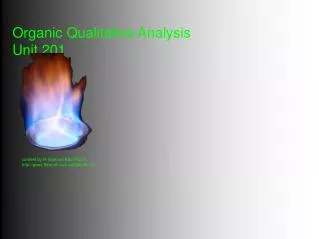
About Combustion All organic compounds contain carbon. All produce CO2 if burnt in air or O2. Steam is also produced. If the amount of O2 is limited CO main form instead of CO2. ethanol burning Flames can be luminous or non-luminous Ethanol does not produce any soot or smoke Benzene and other aromatic compounds can produce lots of soot! (and have luminous flames) Why are they different?
About Combustion Why are they different? Calculate their % C ethanol burning % C = mass of carbon/total mass x 100% C6H6 C2H5OH
Which of these would produce the greatest amount of soot burning? a C8H18 b CH3CHO c CH3COOC2H5 d C5H11OH
orange precipitate carbonyl derivative of 2,4 -DNPH
+ propanone + propanal
Ketones do not react with Fehlings solution http://www.absoluteastronomy.com/topics/Fehling's_solution
This is usually called the silver mirror test! We will do this next week
+ Na H2 Na