
Microbiota Evolution in E. coli and E. faecalis Groups
Study on evolution of E. coli and E. faecalis in monoxenic and dixenic groups using RT-qPCR quantification of bacterial species. Monitoring of bacterial groups at different time points after inoculation. Comparison of human and farm animal microbiota.

Microbiota Evolution in E. coli and E. faecalis Groups
E N D
Presentation Transcript
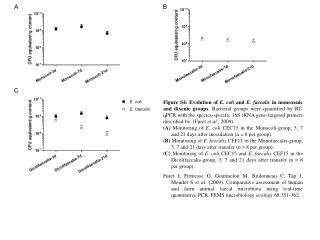
A B C Figure S4: Evolution of E. coli and E. faecalis in monoxenic and dixenic groups. Bacterial groups were quantified by RT-qPCR with the species-specific 16S rRNA gene-targeted primers described by (Furet et al., 2009). (A) Monitoring of E. coli CEC15 in the Monocoli-group, 3, 7 and 21 days after inoculation (n = 8 per group). (B) Monitoring of E. faecalis CEF15 in the Monofaecalis-group, 3, 7 and 21 days after transfer (n = 8 per group). (C) Monitoring of E. coli CEC15 and E. faecalis CEF15 in the Dicolifaecalis-group, 3, 7 and 21 days after transfer (n = 8 per group). Furet J, Firmesse O, Gourmelon M, Bridonneau C, Tap J, Mondot S et al. (2009). Comparative assessment of human and farm animal faecal microbiota using real-time quantitative PCR. FEMS microbiology ecology 68:351-362.