
Copy & Annotate
This document explores the proposition of co-education in Greek life, addressing a common question: "Why not?" It examines the role of setting in the opening scene of Jean-Paul Sartre's "Huis Clos" (No Exit), particularly during the Second Empire period in France. The analysis focuses on how the historical context and architectural style influence mood and meaning within the play. By graphically representing these findings, students will better appreciate the interplay between setting and narrative in Sartre's work.

Copy & Annotate
E N D
Presentation Transcript
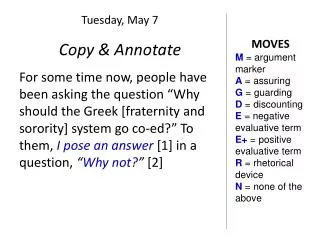
Copy & Annotate Tuesday, May 7 MOVES M = argument marker A = assuring G = guarding D = discounting E = negative evaluative term E+ = positive evaluative term R = rhetorical device N = none of the above For some time now, people have been asking the question “Why should the Greek [fraternity and sorority] system go co-ed?” To them, I pose an answer[1] in a question, “Why not?” [2]
Questions Tuesday, May 7 Passage For some time now, people have been asking the question “Why should the Greek [fraternity and sorority] system go co-ed?” To them, I pose an answer[1] in a question, “Why not?” [2] Is this sentence an explicit performative? Explain the difference between asking “Why?” and asking “Why not?” in this context.
OBJECTIVE After reading the opening scene of Huis Clos [NO EXIT], you will analyze the role of setting [Second Empire] in developing mood and meaning by graphically representing your findings.
Background OBJECTIVE After reading the opening scene of Huis Clos, you will analyze the role of setting [Second Empire] in developing mood and meaning by graphically representing your findings. Tuesday, May 7 HISTORICAL CONTEXT • Huis Clos (No Exit) was presented for the first time at the Theatre du Vieux-Colombier, Paris, in May 1944.
Background OBJECTIVE After reading the opening scene of Huis Clos, you will analyze the role of setting [Second Empire] in developing mood and meaning by graphically representing your findings. Tuesday, May 7 SECOND EMPIRE • The Imperial Bonapartist regime of Napoleon III from 1852 to 1870 C.E. • An architectural style, most popular between 1865 and 1880 C.E.
Opera Garnier, Paris OBJECTIVE After reading the opening scene of Huis Clos, you will analyze the role of setting [Second Empire] in developing mood and meaning by graphically representing your findings. Tuesday, May 7
OBJECTIVE After reading the opening scene of Huis Clos, you will analyze the role of setting [Second Empire] in developing mood and meaning by graphically representing your findings. Tuesday, May 7 Opera Garnier, Paris
OBJECTIVE After reading the opening scene of Huis Clos, you will analyze the role of setting [Second Empire] in developing mood and meaning by graphically representing your findings. Tuesday, May 7 Opera Garnier, Paris
OBJECTIVE After reading the opening scene of Huis Clos, you will analyze the role of setting [Second Empire] in developing mood and meaning by graphically representing your findings. Tuesday, May 7 Opera Garnier, Paris
OBJECTIVE After reading the opening scene of Huis Clos, you will analyze the role of setting [Second Empire] in developing mood and meaning by graphically representing your findings. Tuesday, May 7 Opera Garnier, Paris
Background OBJECTIVE After reading the opening scene of Huis Clos, you will analyze the role of setting [Second Empire] in developing mood and meaning by graphically representing your findings. Tuesday, May 7 Second-Empire Furniture: Dark woods, especially mahogany and ebony. Papier-mâché, cast iron, mother of pearl and ivory inlay, gilt bronze and wood carved to imitate bamboo (faux bamboo).
OBJECTIVE After reading the opening scene of Huis Clos, you will analyze the role of setting [Second Empire] in developing mood and meaning by graphically representing your findings. Tuesday, May 7 Opera Garnier, Paris
Background OBJECTIVE After reading the opening scene of Huis Clos, you will analyze the role of setting [Second Empire] in developing mood and meaning by graphically representing your findings. Tuesday, May 7 Second-Empire Furniture: Heavy curtains and hangings loaded with braids and trimmings.
Huis Clos OBJECTIVE After reading the opening scene of Huis Clos, you will analyze the role of setting [Second Empire] in developing mood and meaning by graphically representing your findings. Tuesday, May 7 DRAMATIS PERSONAE • Valet • Garcin • Estelle Volunteers? • Inez • Narrator
Ticket Out Answer the following question in one sentence: How do Sartre’s descriptions of the setting develop mood and meaning in the opening scene of No Exit ? In the opening scene of No Exit, Sartre’s descriptions of setting develop a mood of _______ by _____________________________.