Understanding Indirect Object Pronouns: Usage and Placement in Sentences
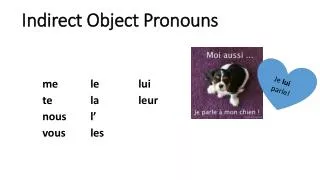
Indirect object pronouns (IOPs) answer the question of "to whom" or "for whom" an action is performed. They replace indirect object nouns and appear before conjugated verbs, before infinitives, or after conjugated verbs in affirmative commands. For instance, in French: "Je parle à la fille" (I talk to the girl) can be replaced with "Je lui parle" (I talk to her). IOPs like "lui" (to him/her) streamline conversation by eliminating repetition, serving essential roles in both positive and negative commands.


Understanding Indirect Object Pronouns: Usage and Placement in Sentences
E N D
Presentation Transcript
Indirect Object Pronouns • What does an indirect object noun do? • Answers the question to whom/for whom • Replaces word à + noun (person) • Replaces an indirect object noun
Example: English • He is talking to the girl. • To whom is he talking? • To the girl = indirect object noun • With what can you replace to the girl? • To her = indirect object pronoun
Placement of IOP • Present tense: • Before the conjugated verb • Sentence with an infinitive: • Before the infinitive • Affirmative command: • After the conjugated verb and connected with hyphen • Negative command: • Before the conjugated verb
Example: present • Je parle à la fille. • To whom am I talking? • à la fille = indirect object noun • With what can you replace à la fille • to her = lui Je lui parle. ( I am talking to her)
Example: infinitive • Je vais parler à la fille. • To whom am I going to talk? • à la fille = indirect object noun • With what can you replace à la fille • to her = lui Je vais lui parler. ( I am going to talk to her)
Example: + command • Parle au garçon. • Talk to whom? • au garçon= indirect object noun • With what can you replace au garçon • to him = lui Parle - lui. ( Talk to him)
Example: - command • Ne parle pas au garçon. • Don’t talk to whom? • au garçon= indirect object noun • With what can you replace au garçon • to him = lui Ne lui parle pas. ( Don’t talk to him)