Warm-up Wednesday, September 12th
30 likes | 179 Vues
Explore the lives of early hunter-gatherers who thrived during the Paleolithic Era, a time when human beings created basic tools and mastered the use of fire. These ancient people, living in small bands and nomadic groups, relied on simple technologies to survive in harsh environments. Discover how their advancements, such as improved tools for hunting and gathering, shaped their societies and lifestyles. Learn about the distinctions between Neanderthals and modern humans, including the development of language and cultural practices that defined social interactions.


Warm-up Wednesday, September 12th
E N D
Presentation Transcript
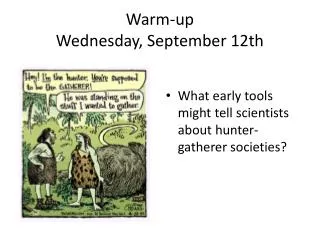
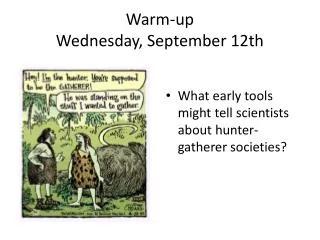
Warm-upWednesday, September 12th • What early tools might tell scientists about hunter-gatherer societies?
Hunter-Gatherer Societies Section 2 • Early humans were hunter-gatherers How Early Hunter-Gatherers Lived • Archaeologists know very little • Lives were often harsh • To survive and grow they developed technology The Development of Tools • Paleolithic Era (means “old” and “stone”) • Time when humans learned how to make tools out of stones • Lasted from 2.5 million years ago to 10,000 years ago • At first, tools were simple: chopping down small trees, cutting meat, scraping animal skins clean. • Over time- tools became better: weapons, hunting larger animals The Use of Fire • During Paleolithic era- fire was used: light at night, cooking meat and plants, scare off dangerous animals • Man is no longer restricted in his movement to a limited range of climates
Wandering Bands • The culture of early societies was simple. • Lived in small groups or bands: 10-12 adults and their children • Nomads- move from place to place with the seasons • Built temporary shelters- another major advance • Men hunted, women gathered Later Stone Age Peoples Neanderthals • Appeared in Europe and Asia 200,000 years ago • Name comes from Neander Valley in Germany • Appeared in late Paleolithic Era and only group to survive Stone Age • First people to bury their dead- believed in life after death Modern Humans • Appeared about 100,000 years ago and were called “Homo sapiens” (wise people) • Similar to Neanderthals- made tools, used fire, and hunted animals • Taller and less muscular and developed a complex language • Language- organize hunt, warn of danger, pass knowledge or skills on • No evidence of Neanderthals after about 28,000 years ago