Download
1 / 3
40 likes | 170 Vues
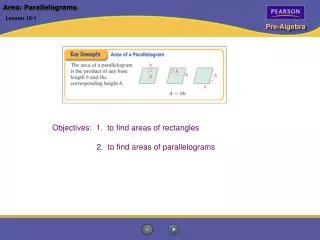
A parallelogram is a four-sided figure with opposite sides that are both parallel and equal in length. To calculate the area of a parallelogram, the formula A = b x h is used, where A represents the area, b is the length of the base, and h is the height. By applying this formula, you can find the area of any parallelogram. Discover more about parallelograms and how to calculate their area on pages 141-142 of your reference materials.

E N D
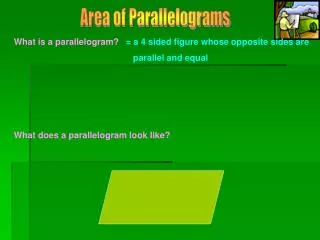
Area of Parallelograms What is a parallelogram? =a 4 sided figure whose opposite sides are parallel and equal What does a parallelogram look like?
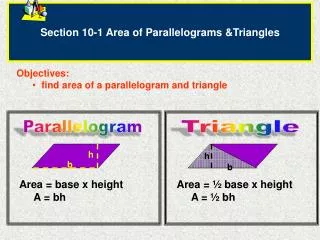
What is the formula for finding the area of a rectangle? A = l x w Formula for finding the area of a parallelogram = A = b x h which means: area equals base times height
How would you find the area of these parallelograms? Text pages 141 -142