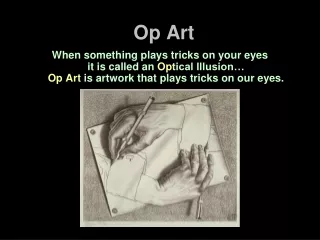
Exploring Op Art: The Dance of Black Dots and Visual Perception
Op Art, developed in the 1950s-60s, captivates viewers with its use of contrasting colors that create involuntary eye movements. This abstract art form employs hard-edge painting techniques and geometric simplicity. Key elements include balance, pattern repetition, high contrast, and the interplay of positive and negative space. Artists like Josef Albers, Bridget Riley, Victor Vasarely, and M.C. Escher utilized these principles to challenge perceptions and evoke dynamic visual experiences. Dive into the mesmerizing world of Op Art and discover its intriguing effects on our visual perception.
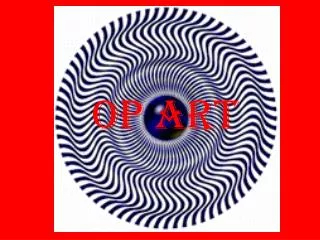

Exploring Op Art: The Dance of Black Dots and Visual Perception
E N D
Presentation Transcript
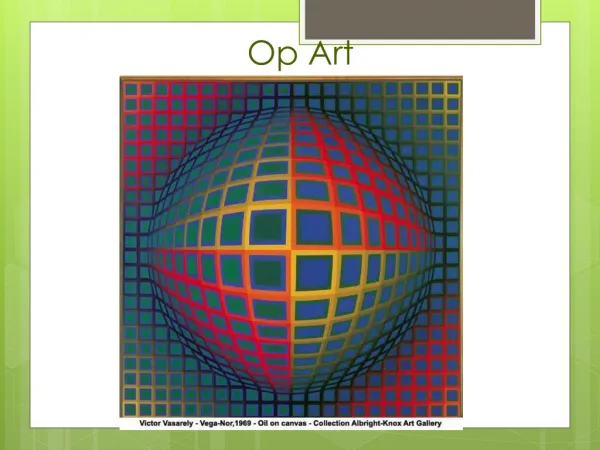
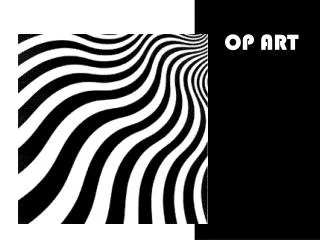
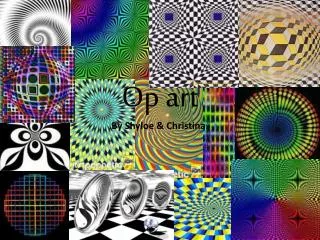
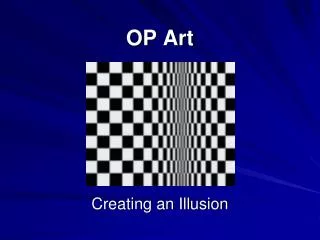
Op Art • Developed in the 1950s-60s • Op Art uses equal values of contrasting colors to cause the viewers eye to move involuntarily. • This was a total Abstract form of art.
Hard-edge painting- style of art in which the artist uses crisp edges. No brushstrokes. • Abstract Art- a style of art that shows objects in simplified arrangements of shape, line, texture, and color. Often geometric.
Op Art Elements & Principles • Balance: is it symmetrical or asymmetrical? • Pattern: “Multiplicity of Simplicity”…using the same simple pattern over and over and over… • Color: Not necessary, high contrast of black and white gives powerful result. • Assimilation: our tendency to minimize things and make them appear uniform. • Contrast: exaggerating differences. • Negative & Positive: negative surrounds positive, it is behind the figure. Positive is the figure.
Line- always gives us positive space. It is an abstract concept. • Multiple grouping- when we are confronted by several stimuli and how we organize it. • Good figure- the perceptual ability to predict the total entity from minimum information. • Proximity- objects that are near one another have a tendency to group. • Similarity- all similar things have a tendency to group.
Op Artists Josef Albers