Understanding Individual and Group Identities: A Framework for Social Processes and Differences
This text delves into the complex constructions of identity, both individual and group-based, exploring how social processes shape our understanding of difference. The concepts of essentialism, positivism, and constructionism are examined, highlighting how social identities, including sexual and ethnic identities, are formed through psychological mechanisms. It also analyses the dynamics of individualism and collectivism in American society, emphasizing the impact of power on identity definitions. The development of white identity and the stages in this transformation are discussed, along with the role of gender identification in a patriarchal social structure.
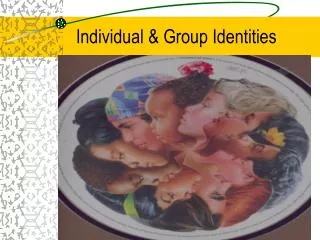

Understanding Individual and Group Identities: A Framework for Social Processes and Differences
E N D
Presentation Transcript
Essentialism/ Positivism Entities exist outside oneself Constructionism Social processes determine the importance and meaning of difference E.g., Chris Yates in TMOD p. 5 (Rosenblum & Travis, 1996) Sexual Identity…Orientation V. Preference Difference Frameworks
Difference From…. • Who has the power to determine what/who is different? • Frankenburg (1996) In America “whites are the nondefined definers of other people.” e.g., European People in boats (Us) V. Indigenous People on land (Them) • How do we identify ourselves?
Identity Formation • Identity= the condition of being some specific person as fashioned by self and society • Identification= the psychological process wherein children try to look, act, feel and be like significant people in their social environment as part of their identity formation
Identification Mechanisms • Differentiation (Freud’s,1921 primary/secondary identification) • Affiliation (Chodorow, 1974) • Imitation and Social learning (Bandura, 1969; Mischell, 1966) • Cognitive schema Independent V. Interdependent Construals • Social patterns impacting attitudes, beliefs, cognitions, norms, values, goals, and family structures
Individualism, An Independent Construal • A cultural pattern stressing autonomy and independence • Focus on a “nuclear family” • More tolerant of practices like divorce • More libertarian
Collectivism– An Interdependent Construal • Social pattern of closely linked individuals who define themselves as interdependent members of a collective (e.g., family, coworkers, etc.) • Large family living closely • Greater conformity • Focus on “in-group” v. “out-group”
United States • U.S. mainstream society tends to be individualistic/independent • However, U.S. parallel cultures tend to be collectivistic/interdependent
United States Southern States as Collectivistic • Oppositional racial consciousness= unity in opposition I.e., minority group reacting to a powerful, hostile majority • Agrarian society • Relative poverty.…. Social dependence • Church life…. Fundamentalism
Mountainwest & Great Plains as Individualistic • Tend to be individualistic • Southwest I.e., NM, AZ, NV, CA are collectivistic due to Latino culture • UT is more collectivistic due to Mormon influence • HI is collectivistic due to Asian influence
Ethnic Identity Formation • Social Identity: The part of a person’s self-concept that is based on identification with a nation, culture, or group or with gender or other roles in society. • Ethnic Identity: A person’s identification with a racial, religious, or ethnic group. • Acculturation: The process by which members of minority groups come to identify with and feel part of the mainstream culture.
White Identity FormationHelms (1995) • Two major developmental tasks must be achieved for Whites to form a healthy white identity: 1- The abandonment of individual racism 2- The opposition to institutional and cultural racism
Contact • Little attention is given to their ethnic identity • Perceive selves as color blind • Perceive racism as the prejudiced behaviors of individuals rather than as a system
Disintegration • Growing awareness of racism & White privilege • Discomfort w/ feelings of shame, guilt & anger in recognizing own prejudices & that of family • Begin to recognize how much their lives & those of people of color have been affected by society’s racism • Social pressure from friends & acquaintances to not notice racism may be powerful
Reintegration • Feelings of guilt & denial may be transformed into fear & anger directed toward people of color • Frustration over being seen as a group member rather than as an individual • As meritocracy is facilitated by individualism, questions about society & one’s accomplishments arise • Tired of being “tested”.
Pseudo-Independence • Greater awareness of institutional racism • Greater commitment to unlearn one’s racism • Fear of speaking in groups w/ people of color due to fear of revealing white privilege • Seek support of other White allies who are further along in this process
Immersion/Emmersion • Redefinition of Whiteness • Guilt & Shame fade • Involvement in White antiracist groups
Autonomy • New identity of “whiteness” is incorporated into personal identity • This positive identity energizes the individual to confront racism & oppression in their daily lives • Open to new information & new ways of thinking about racial/cultural variables • Reawakened sense of empowerment
Gender IdentityKohlberg (1966) • Sex-role identity (age 3) • Sex-role stability (early childhood) • Sex-role constancy (age 5)
1_ Discomfort with heterosexual & patriarchal nature of socialization 2_ Labeling self as different from other men/women 3_ Becoming aware of gayness/lesbianism 4_ Finding and becoming involved in gay/lesbian community 5_ Educating self about gay/lesbian lifestyle Gay IdentityLewis (1979) Five Stages of Gay/Lesbian Identity Development
Ideological Lesbians Women who can be viewed as radical feminists for whom a lesbian lifestyle is politically correct Personal Lesbians Women concerned with establishing an independent identity who find homosexuality supportive of this goal and who view lesbianism as a choice Interpersonal Lesbians Women who find themselves involved with another women and who experience their involvement as a discovery rather than a choice Three Groups of LesbiansHenderson (1979)