D6 Antibacterials
This article explores the historical development of penicillin, from its accidental discovery by Alexander Fleming in 1928 to its modern applications. We discuss how penicillin works to inhibit bacterial growth, the importance of patient compliance, and the dangers of overprescribing antibiotics, leading to antibiotic-resistant bacteria like MRSA. Our examination highlights the contributions of key figures like Paul Ehrlich and the progression of antibacterial treatments, offering insights into the balance between effective treatment and the emerging challenges of resistance.

D6 Antibacterials
E N D
Presentation Transcript
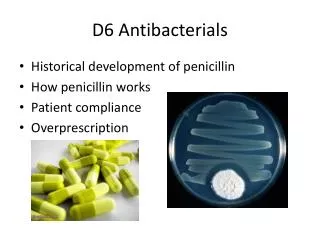
D6 Antibacterials • Historicaldevelopmentof penicillin • How penicillin works • Patient compliance • Overprescription
Bacteria • Bacteria are single cells with a protective cell-wall made up of complex structures of Peptidoglucans • They have a single chromosome- a plasmid • Anaerobic (no need of oxygen) or aerobic (need oxygen) • Some cause diseases, others are beneficial • Antibacterial are chemicals that prevent growth and multiplication of bacteria
Earlyantibacterials • Trypan red, developed by the german chemist Paul Erlich (1854-1915) tocuresleepingsickness • Arsenamine, Salvarsan, wasdevelopedtocuresyphilis. Paul Erlichresponsible • Prontosil, a sulphadrug, usedagainststreptococcalbacteria (1935) • Penicillin (1928)!
Fleming 1928 • WorkedwithStaphylococcusaureus • Leftpetridishwhenhewent on holiday • Discovered on comeback that it hadmoulded • The mouldproduced a substancethatinhibitedgrowthof the bacteria • Hecalled the substance penicillin, butdidn’tpursuehisdiscovery http://www.youtube.com/watch?v=7qeZLLhx5kU
Florey and Chain 1941 • Learnedhowtoisolate and purify penicillin • Used penicillin on policemenwhowasdying from septicaemia (bloodpoisoning) • The structureof penicillin wasdetermined in 1950’s- chemistscould start synthesising it! • Fleming, Florey and Chainrecieved the Noble Prize in 1945
How penicillin works • Interfereswith the enzymethatbuild the cell-wall (which animal cells don’thave) • The weakened cell-walldisintegrateswhile the bacteriumgrows, and it dies • Bacteriacanbecomeresistant by producing an enzymecalledpenicillinase, whichdeactivates the penicillin
Modificationsof penicillin sidechain Benzylpencillin- has to be injected Beta-lactam-ring Benzylpencillinpotassium salt- morewatersoluble and less acidic
Piperacillin- broad spectrumantibiotic Fluocloxacillin- is beta-lactamasestable Amoxillin- better absorbed, used orally
Prescriptionofantibiotics • It’simportanttoeat the wholecureof penicillin and totake it reguarly • To not give the antibioticstosomeoneelse • Specificbacteriacrave different penicillins • Broad- and narrow-spectra penicillin • Combination ofdrugscan be used
Dangerswith over-prescription • Resistantbacteria • Kill ”the good” bacteria • Bacteriabecomes immune- by mutation • Precribedalthough not needed
MRSA-bacteria • Metillicin- ResistantStaphylococcusAureus • The ”super bug” • Makes beta-lactamasewhichdegrades penicillin Meticillin