
Prognostic Value of Landmark Response at 42 Days for Overall Survival by Histology and Treatment
This analysis examines the prognostic values of landmark response categories (progressive disease, stable disease, and partial response) at 42 days post-treatment initiation, stratified by histology, platinum therapy, and combination therapy. Hazard ratios and 95% confidence intervals are reported to evaluate how these factors correlate with overall survival outcomes. The results offer insights into treatment efficacy and patient prognosis based on initial response metrics.

Prognostic Value of Landmark Response at 42 Days for Overall Survival by Histology and Treatment
E N D
Presentation Transcript
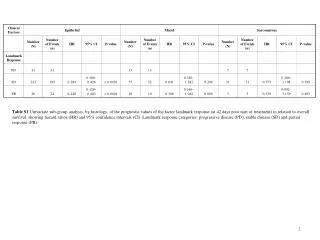
Table S1 Univariate sub-group analysis, by histology, of the prognostic values of the factor landmark response (at 42 days post start of treatment) in relation to overall survival, showing hazard ratios (HR) and 95% confidence intervals (CI). Landmark response categories: progressive disease (PD), stable disease (SD) and partial response (PR).
Table S2 Univariate sub-group analysis, by platinum therapy, of the prognostic values of the factor landmark response (at 42 days post start of treatment) in relation to overall survival, showing hazard ratios (HR) and 95% confidence intervals (CI). Landmark response categories: progressive disease (PD), stable disease (SD) and partial response (PR).
Table S3 Univariate sub-group analysis, by combination therapy, of the prognostic values of the factor landmark response (at 42 days post start of treatment) in relation to overall survival, showing hazard ratios (HR) and 95% confidence intervals (CI). Landmark response categories: progressive disease (PD), stable disease (SD) and partial response (PR).
Table S4 Univariate sub-group analysis, by response evaluation criteria, of the prognostic values of the factor landmark response (at 42 days post start of treatment) in relation to overall survival, showing hazard ratios (HR) and 95% confidence intervals (CI). Landmark response categories: progressive disease (PD), stable disease (SD) and partial response (PR).
