Download
1 / 17
170 likes | 286 Vues
Welcome to PHY 2048C! This course combines lectures, tutorials, and labs to help students grasp the fundamental principles of physics, including the study of matter, energy, time, and space. You'll engage in problem-solving practice, explore the textbook "Physics for Scientists and Engineers" by Tipler and Mosca, and use a Personal Response System (PRS) clicker for quizzes that can earn extra credit. Your grades will be based on mini-exams, mid-terms, finals, lab work, and homework. Join us on a journey to understand the rules that govern our universe!

E N D
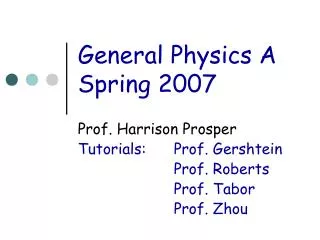
General Physics ASpring 2007 Prof. Harrison Prosper Tutorials: Prof. Gershtein Prof. Roberts Prof. Tabor Prof. Zhou
Welcome to PHY 2048C! • Lectures • Learn and apply principles • Tutorials • Practice problem solving • Labs • Learn basic experimental techniques
Welcome to PHY 2048C! • Textbook Physics for Scientists and Engineers, Volume 1, Paul A. Tipler Gene Mosca
Welcome to PHY 2048C! • Personal Response System You will use your PRS “clicker” to answer questions in class This is how you can earn extra credit
Welcome to PHY 2048C! • Grades • Mini-Exams 35% • Mid-Term 15% • Finals 20% • Labs 20% • Homework/Tutorials 10%
What is Physics? • The study of • Matter • Energy • Time • Space
Mankind’s Greatest Discovery The Universe is understandable Why? Because it works according to definite rules Moreover, the rules are mathematical
Chapter One: Systems of Measurement • S.I. Units • Length meters (m) • Time seconds (s) • Mass kilograms (kg)
Chapter OnePowers of 10 • 10-9 nano (n) • 10-6 micro (m) • 10-3 milli (m) • 103 kilo (k) • 106 mega (M) • 109 giga (G)
Chapter One Units are Important! http://www.cnn.com/TECH/space/9909/30/mars.metric.02
Chaper One:Dimensional Analysis • Question 62, page 16 • Period T of pendulum depends on length L and acceleration due to gravity g • Let’s derive an approximate formula for the period
Chapter One: Significant Figures • Every measurement has a degree of uncertainty • Therefore it makes sense to round off numbers in some reasonable way
Chapter One: Significant Figures • Example: • A square table has a measured area of 3.5 m2 • It would be absurd to write the length of each side as 1.870828693 m! • 1.87m is more sensible.
Chapter One: Order of Magnitude • This is a number rounded off to the nearest power of 10 • Examples: • Federal Budget ~ $3 trillion • Human lifespan ~ 100 years
Chapter One: Order of Magnitude • Let’s do an order of magnitude calculation of • the mass of air supported by your body
Chapter One: End • Try this “Fermi Question” • How many drops of rain fall in a typical rain storm in Tallahassee?