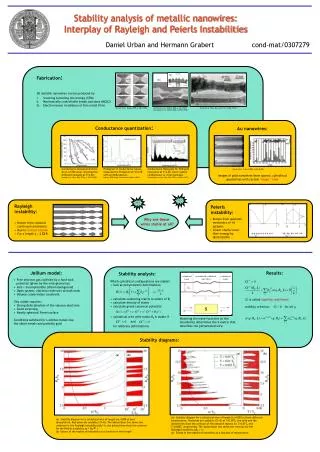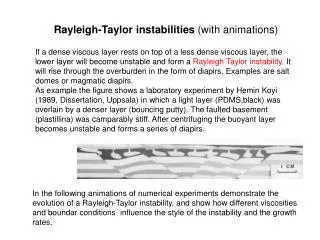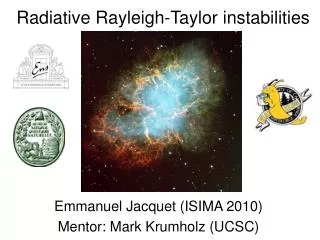
Radiative Rayleigh-Taylor instabilities
350 likes | 513 Vues
This presentation explores the radiative Rayleigh-Taylor instabilities with a focus on their implications in astrophysical contexts, specifically during massive star formation and in HII regions. It delineates the fundamental principles and explores both optically thin and optically thick limits. The analysis highlights the dynamics of radiation transfer in non-relativistic hydrodynamics, providing insight into the instability criteria and growth mechanisms under varying conditions. These insights enhance our understanding of radiation's role in astrophysical systems and their evolution.


Radiative Rayleigh-Taylor instabilities
E N D
Presentation Transcript
Radiative Rayleigh-Taylor instabilities Emmanuel Jacquet (ISIMA 2010) Mentor: Mark Krumholz (UCSC)
Outline • Introduction and motivation • Fundamentals and generalities • The (very) optically thin limit • The (very) optically thick limit • Conclusion
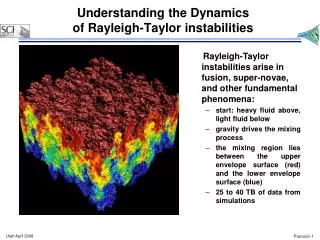
Classical Rayleigh-Taylor instability • Two immiscible liquids in a gravity field • If denser fluid above unstable (fingers).
Motivation 1: massive star formation • Radiation force/gravity ~ Luminosity/Mass of star. • >1 for M>~20-30 solar masses. • But accretion goes on… (Krumholz et al. 2009) : radiation flows around dense fingers.
Motivation 2: HII regions • Neutral H swept by ionized H • Radiative flux in the ionized region RT instabilities? And more!
The general setting Width Δz of interface ignored. z=0+ - - - - z=0-
Equations of non-relativistic RHD gas Radiation Energy Rate of 4-momentum transfer from radiation to matter Momentum
Linear analysis: the program (1/2) • Dynamical equations: • Perturbation: • Search for eigenmodes: • Eulerian perturbation of a quantity Q: • If Im(ω) > 0: instability! • Lagrangian perturbation:
Linear analysis: the program (2/2) • Perturbation equations still contain z derivatives: • Everything determined at z=0 so should dispersion relation. • Importance of boundary conditions.
Boundary conditions z>0 • Normal flux continuity at interface in its rest frame: • From momentum flux continuity: • Perturbations vanish at infinity. z<0 ≈ 0
Absorption and reradiation in an optically thin medium • Higher opacity for UV photons dominate force Hard photon attenuation Radiative equilibrium visible near infrared
So we should solve: Let us simplify… with: ?
Discontinuity in sound speed. Assume ρ-independent opacity and constant F in each region constant T and effective gravity field: Constant 2x2 matrix A: Isothermal media with a chemical discontinuity eff
Instability criterion 1 • (Pure) instability condition: • Dispersion relation: • Growth rates: 2 Ex. of unstable configuration with:
Optically thick limit • Radiation Planckian at gas T (LTE) • Radiation conduction approximation. • Total (non-mechanical) energy equation: • Conditions:
Meet A again: with:
Adiabatic approximation • Rewrite energy equation as: • If we neglect Δs=0. • …under some condition: with
Perturbations evanescent on a scale height • A traceless must be eigenmode of A: • Pressure continuity:
Rarefied lower medium • Dispersion relation: in full: • In essence: • Really a bona fide Rayleigh-Taylor instability! Unstable if g>0
Domain of validity No temperature locking Convective instability? Not local Not optically thick Window if: Not adiabatic E=x=1
So what about massive star formation? • Flux may be too high for « adiabatic RTI » • But if acoustic waves unstable : « (RHD) photon bubbles » (Blaes & Socrates 2003) • In dense flux-poor regions, « adiabatic RTI » takes over. • growth time a/g (i.e. 1-10 ka). • Tentative only…
Summary: role of radiation in Rayleigh-Taylor instabilities & Co. Characteristic length/photon mean free path >> 1 << 1 1 OPTICALLY THIN adiabatic isothermal OPTICALLY THICK Flux sips in rarefied regions: buoyant photon bubbles (e.g. Blaes & Socrates 2003) Radiation as effective gravity (« equivalence principle violating ») Radiation modifies EOS, with radiation force lumped in pressure gradient