
Marzo 2005
This study explores the impacts of oil concentrations on mesozooplankton communities, including ciliates, flagellates, and bacteria, across three time points in 2005. In March, a prevalence of diatoms was noted that outcompeted bacteria for nutrients with no observed effect of oil on chlorophyll or nutrients. In July, ciliates emerged as more abundant, raising questions about their resilience to oil. By September, conditions seemed stable, maintaining diatom dominance with few top predators present. The findings suggest complex interactions between oil, temperature, and zooplankton dynamics.
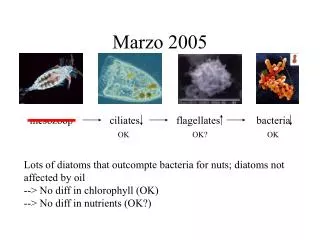

Marzo 2005
E N D
Presentation Transcript
Marzo 2005 mesozoop ciliates flagellates bacteria OK OK? OK Lots of diatoms that outcompte bacteria for nuts; diatoms not affected by oil --> No diff in chlorophyll (OK) --> No diff in nutrients (OK?)
Julio 2005 mesozoop ciliates flagellates bacteria OK OK? OK Lots of heterotrophs; ciliates 5 times more abundant; chla dominated by picoplankton (small flagellates). --> ciliates will feed on both hetero and auto flags; chla (OK) --> puzzle: why are ciliates not affected negatively like in Mar? Maybe: lots of ciliates, some effect of oil but effect on zoop more important because of tight coupling... --> overall puzzle: other experiments show no effect of these oil concentrations on copepods!?... --> interaction with temp? (all processes are faster, thus effects on larger organisms can be transmitted down the food chain?)
September 2005 mesozoop ciliates flagellates bacteria OK? OK? OK Expect similar situation than in March... --> chla unaffected (OK) because of diatom dominance and few top predators (OK?)