DNA Replication
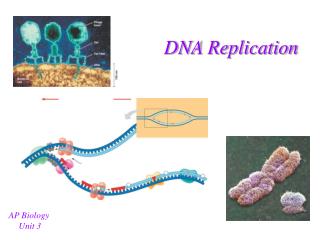
DNA Replication. AP Biology Unit 3. Hershey & Chase Experiment. Bacteriophages are viruses that infect bacteria Bacteriophages consist of DNA and protein (capsid) What part of the bacteriophage holds the instructions of how to make more viruses? DNA.

DNA Replication
E N D
Presentation Transcript
DNA Replication AP Biology Unit 3
Hershey & Chase Experiment • Bacteriophages are viruses that infect bacteria • Bacteriophages consist of DNA and protein (capsid) • What part of the bacteriophage holds the instructions of how to make more viruses? • DNA
Hershey & Chase: determined that DNA is the genetic material
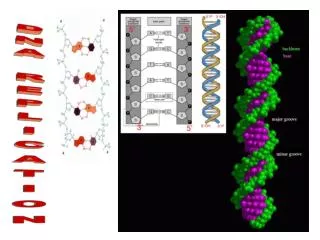
DNA Structure • Double Helix (2 strands of DNA) • Complementary strands pair up (A & T, C & G)– hydrogen bonds • Strands are antiparallel (5’ and 3’ ends)
DNA Replication • When DNA is copied during S Phase of Interphase • Basic Concept = create a new strand by matching nucleotides to an existing strand
DNA Replication • Replication is semi-conservative (one strand is old, one strand new)
Origins of Replication • Where DNA Replication starts • Differs between organisms • Prokaryotes = 1 origin of replication • Eukaryotes = many different origins of replication
General Process of DNA Replication • Step 1: Initiator Proteins bind to origins of replication to begin replication • Attracts other enzymes involved in replication process
General Process • Step 2: • DNA Helicase separates the DNA helix • Topoisomerase (Gyrase) prevents “overwinding” of DNA • Single Stranded Binding Proteins (SSBs) prevent double helix from reforming temporarily
Question… • What kind of bonds does Helicase break? • Hydrogen bonds
Primase 5’ 3’ 5’ RNA Primer DNA Polymerase III General Process • Step 3: Primase builds an RNA primer at the starting from the 5’ end of the new DNA strand • Uses the 3’ end of existing DNA strand • Why? Because the DNA Polymerase III (main DNA building enzyme) needs something to build off of
General Process • Step 4: DNA Polymerase III builds the new strand of DNA in a 5’ to 3’ direction • What kinds bonds are being formed to make a new strand of DNA? • Covalent bonds
Question… • What other enzyme builds similarly to DNA Polymerase III? • RNA Polymerase (don’t mix it up with DNA Polymerase III!)
Problem… • How can both strands of DNA be replicated in a 5’- 3’ direction at the same time they are antiparallel? • Answer: leading and lagging strands
Leading and Lagging Strands • Leading strand is synthesized continuously in the direction of replication (goes in the same direction as helicase) • Lagging strand is synthesized in short fragments the opposite direction of replication (opposite direction as helicase)
Questions… • How many primers does the leading strand need? • Only 1– to start replication • How many primers does the lagging strand need? • Many – one for each Okazaki fragment
DNA Ligase • DNA Ligase seals Okazaki fragments together • Forms covalent bonds between nucleotides to create a continuous strand of DNA
Finishing DNA Replication • Problem #1: There are still RNA nucleotides in the DNA (primers) • Solution = DNA Polymerase I cuts out the RNA nucleotides and replaces them with DNA
Finishing DNA Replication • Problem #2: Okazaki fragments and bases replaced DNA Polymerase I are not attached to rest of DNA • Solution = DNA Ligase seals everything together
Putting It All Together • Label the diagram on Page 67 with the following terms: • SSBs - DNA Ligase • Leading Strand - Lagging Strand • Helicase - Primase • DNA Polymerase III - Primer • DNA Polymerase I
SSBs DNA Polymerase III Helicase Leading Strand DNA Ligase DNA Polymerase I DNA Pol III Primase Lagging Strand Primer