Download
1 / 7
70 likes | 193 Vues
This article explores the essential aspects of measurement system evaluation, emphasizing the need to distinguish between process variation and measurement variation. It delves into metrology—the science of measurement—and sets goals for achieving zero measurement error. Key concepts such as accuracy, precision, repeatability, and reproducibility are defined, alongside practical applications and tools used in measurement. The article outlines a structured approach for evaluating measurement systems, including operator selection, calibration, and the importance of independent verification to ensure reliability and compliance with standards.

E N D
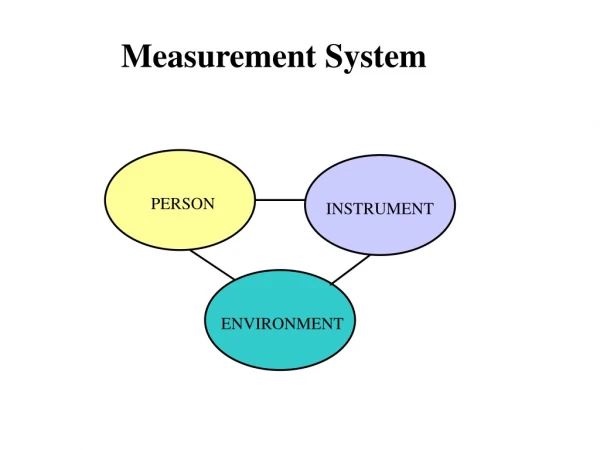
Needed because total variance of process recorded is the sum of process variation and measurement variation • Thus, when there is a special cause, always look first at measurment tool
Metrology: the science of measurement • Goal: zero error in measurement • accurate: difference between true value and observed • Precision: variability of accuracy • Repeatability: variation when same instrument is used by same operator, this variance is often called equipment variation • Reproducible: is the same accuracy and precision seen across all operators
Low Technology • calibers • tapes • observation, count • thermometer • scales
High Technology • lasers • optics • microprocessors • sound • chemical
Evaluation and verification of measurement • Select m operators and n parts (samples), minimum of two operators and 10 parts • calibrate measuring instrument against standard • have each operator measure each part in random order for a minimum of 2 trials • Compute means and ranges EV, AV R&R and these as percent of tolerance range, see excel folder 'Measurement Evaluation Example'
Calibration • Required if selling based on a measure (weight, size, concentration) • Measuring instrument has to be verified by independent entity, usually government and/or industry • Have to confirm calibration throughout time (self and independent entity) • Evaluation of equipment (is it sound) What tolerances are needed by device What tolerances are allowable (specifications) How to calibrate How often does device need tested Random testing schedule Documentation and reporting system Independent evaluator doing their schedule