Exploring Recursion and Fractals: Understanding H-trees and Self-Similarity in Nature
260 likes | 421 Vues
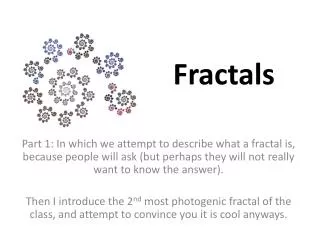
This article delves into the fascinating world of recursion and fractals, focusing on the construction of H-trees and their recursive nature. Recursion is defined through practical examples, contrasting it with iteration. The discussion extends to fractal dimensions, highlighting the complexities of structures like the Koch snowflake and its self-similar properties. We also touch upon the representation of natural phenomena like clouds and coastlines, illustrating how these concepts manifest in real-world patterns. Explore how recursion shapes both mathematics and the natural world.


Exploring Recursion and Fractals: Understanding H-trees and Self-Similarity in Nature
E N D
Presentation Transcript
Beauty in Recursion, Fractals Gur Saran Adhar Computer Science Department
Recursion (key idea) • Letter ‘H’ is an H-tree • An H-tree attached to each end of an H-tree is also an H-tree Define an object in terms of copies of itself
Iteration vs. Recursion int Product(int n) //iteration { inti, result =1; for ( i = 1; i <= n; i++) result = result*i; return(result) } int Product(int n)//recursion { if ( n ==1) return (1); else return(n*Product(n-1)); }
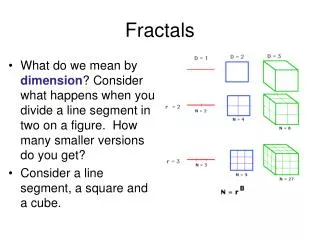
Fractal Dimension D = ln(n)/ ln(1/s) Higher dimension exhibits more jagged surfaces For snowflake D = ln(4)/ln(3) = 1.26
Language of Recursion • Describing a tree Rules A AA B A[B]AA(B)
Structure of Clouds (NASA) in marine stratocumuluson on July 7, 1987. First few frames showing the transition from GOES 1 km to Landsat 0.03 km resolution, and then zoom in by 7 successive factors of 2, to see that what's inside a GOES pixel can look rather similar to what's inside the full 500 km gridbox. This so-called "self-similarity" of clouds is characteristic of fractals.