
### Understanding Threads and Process Execution in Multithreading ###
E N D
Presentation Transcript
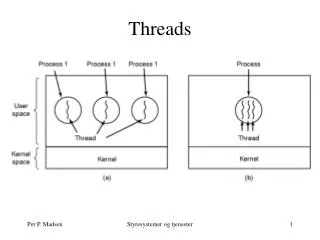
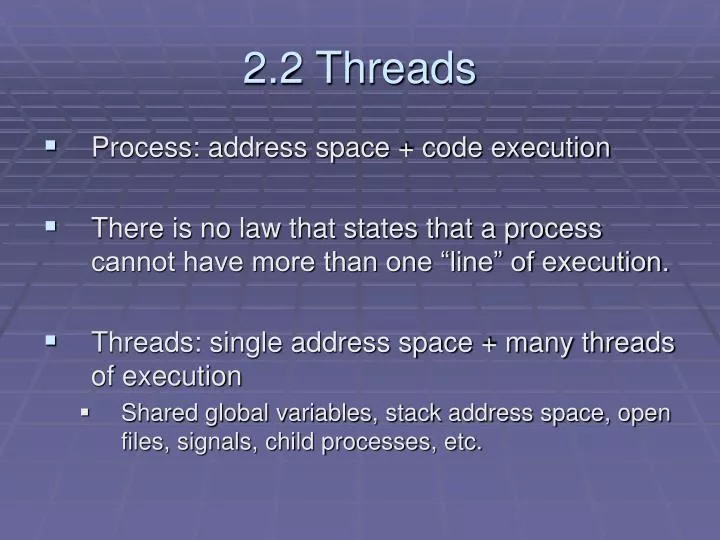
2.2 Threads • Process: address space + code execution • There is no law that states that a process cannot have more than one “line” of execution. • Threads: single address space + many threads of execution • Shared global variables, stack address space, open files, signals, child processes, etc.
Threads • Process – used to group resources together • Threads – entities scheduled for execution on CPU • Sometimes called lightweight processes • Multithreading – multiple threads in the same process
Thread functions • Create threads: #include <pthread.h> int pthread_create ( pthread_t* thread, pthread_attr_t* attr, void* (*start_routine)(void *), void* arg );
Thread termination void pthread_exit ( void* retval ); int pthread_cancel ( pthread_t thread );
Why threads? • Easier to create a thread than a process • Share resources • Compute and I/O within a single process on a single processor can be overlapped • Compute and compute within a single process on a multiprocessor can be overlapped
Example: word processor • Multiple threads: • User interaction • Document reformatting • Automatic saving/backups • Alternative is everything else stops when (2) or (3) occurs.
Example: web server • Dispatcher – handles incoming requests • Workers – performs request • Checks cache • Reads from disk if necessary • Adds to cache
Threads and alternatives • Threads retain the simple sequential, blocking model while allowing for parallelism. • The single threaded server retains the simple sequential, block model but performance suffers (no parallelism). • Finite state machine = each computation has a saved state and there exists some set of events that can occur to change the state • High performance through parallelism • Uses nonblocking calls and interrupts (not simple) • May be in user space or kernel.
Threads • Thread types: • Detached • Joinable • (also popup) • Implementations: • User space • Kernel • Hybrid
Pitfall: global variables #include <stdio.h> bool err = false; void* t1 ( void* p ) { … err = true; if (err) puts( “hello” ); //may never get here! … } void* t2 ( void* p ) { … err = false; … } int main ( int argc, char* argv[] ) { … if (err) puts( “something bad happened.” ); … }
Pitfall: global variables • Solution: don’t use ‘em. • Solution: create thread-wide globals (using your own libraries) • Solution: (other mechanisms that we will explore in the future)
Other pitfalls • Libraries may not be reentrant • Solution: rewrite the library • Solution: wrap each library call with a wrapper • Signals, alarms, and I/O may not be thread specific.
Other pthread functions • int thread_yield() • int pthread_join( pthread_t th, void** thread_return ) • void pthread_exit( void* retval ) • Many, many others