Mastering Skill Development: Effective Strategies for Sport Performance Enhancement
This guide focuses on the systematic design and implementation of skill development in sports. It emphasizes prioritization techniques, including the Pareto Principle (80/20), to enhance training efficacy. Key elements of skill execution are dissected into phases, including setup, windup, force production, and follow-through. Coaches will learn to analyze skills through kinesiology and biomechanics, focusing on motor learning and the development of neural outputs. Emphasis is placed on understanding performance objectives, error analysis, and techniques for maximizing athlete potential in various environments.

Mastering Skill Development: Effective Strategies for Sport Performance Enhancement
E N D
Presentation Transcript
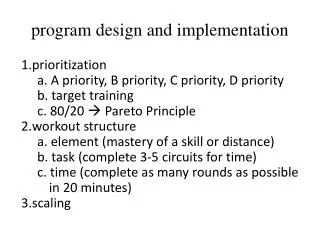
program design and implementation • prioritization • A priority, B priority, C priority, D priority • target training • 80/20 Pareto Principle • workout structure a. element (mastery of a skill or distance) b. task (complete 3-5 circuits for time) c. time (complete as many rounds as possible in 20 minutes) • scaling
Why Heavy Loads? From the Motor Learning Perspective • Highest level of neural outputs best develops skill
Analyzing Sport Skills • Determine objectives • Special characteristics • Elite performers • Divide skill into phases • Divide phases into elements • Understand the kinesiology and physics of each element
Objectives of the Skill • What is the result? • Begin with the end in mind • Overall performance objective • Other objectives that dictate skill performance • Rules of the sport • Physiology energy systems • Biomechanics core to extremity movement
Special Characteristics • Discrete – continuous – serial • Open vs. closed environments
Elite Performances • Visual image of what the skill execution looks like • Assists in the development of the motor program • Watching with intention
Divide Skill Into Phases • Set up (preparatory) • Wind up (backswing) • Force producing movements • Follow through
Key Elements • Distinct actions that result in success • Ex. cross diagonal gait walking/running • Focus on force producing movements when teaching
Mechanical Reasons • The basis of good technique is good physics • Be able to answer the “Why?” of the motion
Observation, Analysis & Correction of Errors • Observe complete skill • Analyze each phase and key elements • Use mechanical principles • Select errors to be corrected • Decide on appropriate techniques
Performance Errors • Major • Seriously detract from performance of skill • Minor • Minimal effect on performance