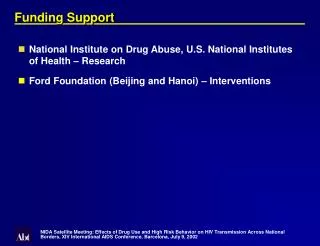
Funding Support
210 likes | 316 Vues
Explore the cross-border dimensions of drug trafficking, drug use, and HIV transmission in Guangxi Province, China, and neighboring areas of Vietnam. The project aims to prevent HIV among drug users through interventions and collaboration.


Funding Support
E N D
Presentation Transcript
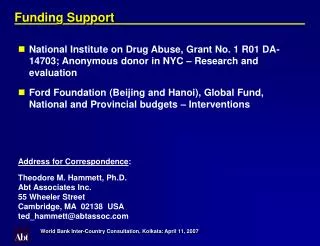
Funding Support • National Institute on Drug Abuse, U.S. National Institutes of Health – Research • Ford Foundation (Beijing and Hanoi) – Interventions
Overview • Geographic Setting • Cross-Border Dimensions of Drug Use and HIV Transmission • Cross-Border HIV Prevention Project
Map of Project Sites China Area of Detail Hanoi Vietnam China Ning Ming City Puzhai Shilang Aidian Tan Thanh Tongmian Key: CaoLoc Town Dong Dang Loc Binh Hop Thanh Large Project Site Langson town Small Border Site Vietnam Geographic Setting
Cross-Border Dimensions • Drug Trafficking Drug Use HIV Transmission • Drug Trans-shipment Routes Golden Triangle Vietnam S. China Hong Kong The World Source: Beyrer et al., AIDS 2000; 14:75-83
Drug Trafficking Drug Use HIV Transmission • Heroin availability along trans-shipment routes shift from traditional opium smoking to heroin smoking/ inhalation heroin injection (cost efficiency) • Heroin injection sharing of injection equipment (pharmacy sale of needles/syringes but problems of cost [users often cannot afford needle/syringe once they pay for drug], and limited business hours) • Sharing of injection equipment HIV transmission
Guangxi Province, China: HIV spreads along drug trans-shipment routes
Guangxi Province, China: HIV spreads along drug trans-shipment routes Source: Guangxi Center for HIV/AIDS Prevention and Control • 21% HIV prevalence among IDUs in Pingxiang (adjacent to Ning Ming), ~10% in Ning Ming (awaiting Cross-Border project baseline survey – July 2002)
Vietnam: Increasing HIV prevalence among IDUs along border with Guangxi • Quang Ninh Province –65% HIV prevalence among IDUs (Sentinel Surveillance, 2000) • Lang Son Province – increasing numbers of cases
Vietnam: Increasing HIV prevalence among IDUs along border with Guangxi HIV Prevalence Among IDUs in Lang Son, 1996-2001 Source: Preventive Medicine Center of Lang Son, December, 2001 • Lang Son: ~80% of HIV cases are IDUs, ~21% HIV prevalence among IDUs (Sentinel Surveillance, 2000) – but concern about sampling makes figure uncertain. Awaits Cross-Border project baseline survey – July 2002
Cross-Border Dimensions • Small-scale movement associated with heroin purchase/sale • Molecular epidemiology (Beyrer, 2000; Yu, 1998, 1999, 2002; Kato, 1999) suggest cross-border HIV transmission probably from N. Vietnam S. China: matching strains of Subtype E found on both sides of border • Border between Guangxi and Lang Son – 200 km, mountainous, porous – 1 official crossing, 5 semi-official, many unmonitored
Small-scale movement associated with heroin purchase/sale (cont.) • Patterns of movement – influences (from formative research, more to come from project surveys): • Price (lower) and purity (higher) in Vietnam – Chinese users cross into Vietnam to buy/use • Law enforcement activity • Wholesale/retail availability: Chinese dealers buy in Lang Son, sell in Ning Ming; Vietnamese users cross into China to buy/use • Vietnamese IDUs/sex workers live in China (e.g., 30% of IDUs in Aidian are Vietnamese)
Cross-Border Dimensions • 3. Trade and Employment • Legitimate business/commercial activity • Migratory labor • “Floating Population” – 1 million in area
Cross-Border Dimensions • 4. Ethnic/Family Ties • Common ethnic minority groups on both sides of border (e.g., Zhuang) • Intermarriage common, although illegal and results in loss of nationality.
Cross-Border HIV Prevention Project • First-ever cross-border HIV prevention project for IDUs • HIV prevalence at possible “take-off” point in Ning Ming and Lang Son • Cross-border dimensions and opportunities project concept and design • Project development: 1997-2001 – many challenges
Intervention • 6 sites in Lang Son, 4 in Ning Ming • Peer-based education of IDUs • Centers in Ning Ming/Field outreach in Lang Son • Public health/infection control • Collection and safe disposal of used needles/syringes • Social marketing of new needles/syringes • Pharmacy/clinic vouchers (China and Vietnam) • Direct exchange also offered (Vietnam)
Intervention (cont.) • Community education • Letters of support from police and other agencies • Regular meetings/community workshops • Job training for peer educators • Support for drug use cessation • Cross-border collaboration
Evaluation • Methods • Pre- and multiple-post intervention followup • Cross-sectional surveys of IDUs (baseline + 6, 12, 24, 36 months) • HIV testing (with counseling) • “Capture-recapture” component HIV incidence estimation, longitudinal behavior change • KAP surveys in community (HIV knowledge, knowledge of/attitudes toward project) • Process data • Peer educator logs (contacts, collection of used needles/syringes) • Pharmacy/clinic logs (vouchers redeemed)
Evaluation (cont.) • Outcomes • Stable HIV prevalence • Low HIV incidence • Reduced high-risk behavior (distributive and receptive sharing of injection equipment) • Reduced high-risk sexual activity • Large-scale safe disposal of used needles/syringes • Increased community awareness of HIV and support for intervention
Conclusions • Path-breaking project • Very important opportunity to reduce cross-border HIV transmission and increase cross-border collaboration • Serious challenges in development and implementation • Collaboration in cross-border projects would be useful in many HIV transmission contexts in many parts of the world