Physics
Range, Projectile, Physics, Experiment

Physics
E N D
Presentation Transcript
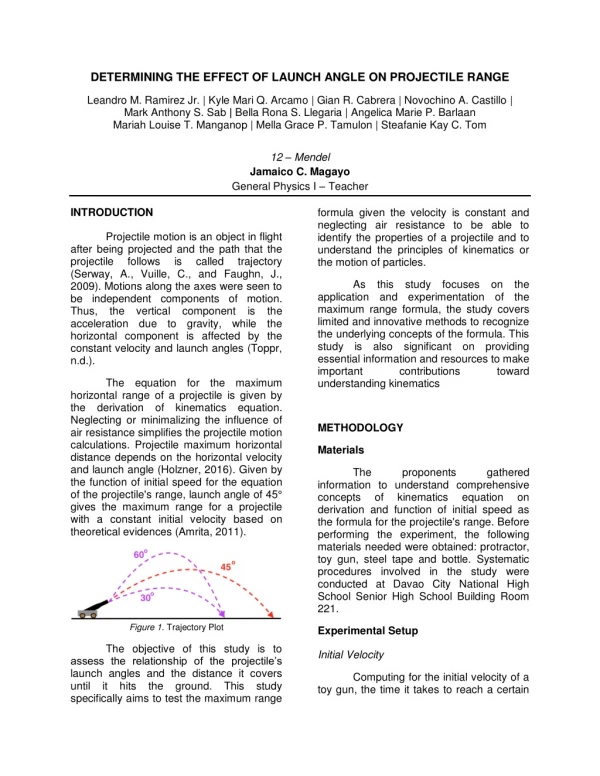
DETERMINING THE EFFECT OF LAUNCH ANGLE ON PROJECTILE RANGE Leandro M. Ramirez Jr. | Kyle Mari Q. Arcamo | Gian R. Cabrera | Novochino A. Castillo | Mark Anthony S. Sab | Bella Rona S. Llegaria | Angelica Marie P. Barlaan Mariah Louise T. Manganop | Mella Grace P. Tamulon | Steafanie Kay C. Tom 12 – Mendel Jamaico C. Magayo General Physics I – Teacher INTRODUCTION formula given the velocity is constant and neglecting air resistance to be able to identify the properties of a projectile and to understand the principles of kinematics or the motion of particles. after being projected and the path that the projectile follows is (Serway, A., Vuille, C., and Faughn, J., 2009). Motions along the axes were seen to be independent components of motion. Thus, the vertical component is the acceleration due to gravity, while the horizontal component is affected by the constant velocity and launch angles (Toppr, n.d.). Projectile motion is an object in flight called trajectory application and experimentation of the maximum range formula, the study covers limited and innovative methods to recognize the underlying concepts of the formula. This study is also significant on providing essential information and resources to make important contributions understanding kinematics As this study focuses on the toward horizontal range of a projectile is given by the derivation of kinematics equation. Neglecting or minimalizing the influence of air resistance simplifies the projectile motion calculations. Projectile maximum horizontal distance depends on the horizontal velocity and launch angle (Holzner, 2016). Given by the function of initial speed for the equation of the projectile's range, launch angle of 45° gives the maximum range for a projectile with a constant initial velocity based on theoretical evidences (Amrita, 2011). The equation for the maximum METHODOLOGY Materials information to understand comprehensive concepts of kinematics derivation and function of initial speed as the formula for the projectile's range. Before performing the experiment, the following materials needed were obtained: protractor, toy gun, steel tape and bottle. Systematic procedures involved in the study were conducted at Davao City National High School Senior High School Building Room 221. The proponents gathered equation on Figure 1. Trajectory Plot Experimental Setup assess the relationship of the projectile’s launch angles and the distance it covers until it hits the ground. This study specifically aims to test the maximum range The objective of this study is to Initial Velocity toy gun, the time it takes to reach a certain Computing for the initial velocity of a
distance at θ = 0° was measured. Using the camera recorder, hitting the bottle at a certain distance (1.13 m) with a toy gun was recorded. Three trials were done to accurately and precisely determine the mean time. The time was determined by taking a video by the time the bullet hits the plastic bottle. The video was then exported to a computer video editor to allow the slow motion visualization and record the specific time accurately. The video taken has a frame rate of thirty (30) frames per second. The average time was then divided by the distance to obtain the velocity (V=3.77 m/s). Figure 4. Diagram for Horizontal Distance Measurement t = 0.30 s d = 1.13 m Figure 2. Diagram for Velocity Measurement Figure 5. Horizontal Distance Measurement Data Analysis determine if there is a significant difference between the actual measurements and the theoretical measurement. The test was carried out using Professional Plus 2013 Data Analysis Toolpak with p=0.05. One-Sample Z-test was used to Figure 3. Initial Velocity Measurement Microsoft Excel Data Collection was determined by measuring the total horizontal distance it covers using steel tape. Three trials were done on each setup angles to accurately determine the mean range of a projectile. All external factors were observed carefully, such as minimal influence by air resistance inside a closed room. Calculating the range of a projectile
RESULTS AND DISCUSSION Hypothesized Mean z P(Z<=z) one-tail z Critical one-tail P(Z<=z) two-tail z Critical two-tail 1.25 -3.16228 0.000783 1.644854 0.001565 1.959964 Table 1. Z-Test: One Sample mean (30°) Mean Known Variance Observations Hypothesized Mean z P(Z<=z) one-tail z Critical one-tail P(Z<=z) two-tail z Critical two-tail 30° 1.233667 0.000279 30 1.25 shows the actual mean (M=1.24) against the theoretical mean (1.25). Since p<0.05, the results suggest there is enough evidence to reject the null hypothesis (μ≠1.25). The result indicated on table 3 -5.32735 4.98E-08 1.644854 9.97E-08 1.959964 The result indicated on table 1 shows the actual mean (M=1.23) against the theoretical mean (1.25). Since p<0.05, the results suggest that there is enough evidence to reject the null hypothesis (μ≠1.25). 1.5 1.45 1.44 1.4 Range (meters) 1.24 1.25 1.3 1.24 1.2 1.25 1.1 Table 2. Z-Test: One Sample mean (45°) Mean Known Variance Observations Hypothesized Mean z P(Z<=z) one-tail z Critical one-tail P(Z<=z) two-tail z Critical two-tail 1 45° 1.441 0.000464 20 30 40 50 60 70 80 Angle of Launch (degrees) Actual Data Theoretical Data 30 1.44 Figure 4. Scatter Plot Representation 0.253456 0.399958 1.644854 0.799916 1.959964 Figure 4 shows the scatter plot representation of the overlapping error bars. The mean for the theoretical range (θ = 30°) is one point twenty-five (1.25) meters while the mean for the actual range is one point twenty-four (1.24) meters. At θ = 45°, the theoretical range is one point forty-four (1.44) meters while the actual range is one point forty-five (1.45) meters. At θ = 60°, the mean for the theoretical range is one point twenty-five five (1.25) meters while the actual range measures one point twenty- four (1.24) meters. The result indicated on table 2 shows the actual mean (M=1.44) against the theoretical mean (1.44). Since p>0.05, the results suggest that there no enough evidence to reject the null hypothesis (μ=1.44). Table 3. Z-Test: One Sample mean (60°) Mean Known Variance Observations 60° 1.237 0.000504 The ranges of the 30° and 60° launch angles should be the same (theoretically) while the 45° launch angle will have the greatest range among the three if 30
the initial horizontal velocity will be held constant. https://www.youtube.com/watch?v= w9zzUxU5zAE The 60° launch angle has the highest peak reached followed by the 45° launch angle and the 30° launch angle. Elert, G., (2019). The Retrieved Physics from Hypertextbook. https://physics.info/projectiles/ Fitzpatrick, R., (2011). Projectile Motion with Air Resistance. http://farside.ph.utexas.edu/teaching /336k/Newtonhtml/node29.html The slight differences between the actual range and the theoretical range were possibly affected due to the external factors such as air resistance. (Singh, S., 2013). There are several factors that relates to the air resistance including speed, mass, surface of the object and surface to volume ratio which creates a force opposite to the direction of a velocity (Fitzpatrick, R., 2011). Retrieved from Henelsmith, N., (2016). Projectile Motion: Finding the Optimal Launch Angle. USA: Whitman College Holzner, S., (n.d.). Calculate the Range of a Projectile Fired Retrieved https://www.dummies.com/education /science/physics/calculate-the- range-of-a-projectile-fired-at-an- angle/ at an Angle. from The 60° launch angle has the highest maximum height reached followed by the 45° launch angle and the 30° launch angle. CONCLUSION Khan Academy. Projectile Launched at an Angle: Review. Accessed July 04, 2019. https://www.khanacademy.org/scien sc/ap-physics-1/ap-two-dimensional- motion/projectiles-launched-at-an- angle-ap/a/projectiles-launched-at- angles The launch angle can affect the range travelled by a particle if the velocity is held constant. The results showed for the 30° and 60° means minimally differs with the theoretical range due to some external factor that might affected the setup. On the other hand, the mean for the 45° provided enough evidence to support the claim. Lumen Learning. Kinematics. Accessed July 05, 2019. https://courses.lumenlearning.com/b boundles-physics/chapter/projectile- motion/ Two-Dimensional The slight differences between the actual range and the theoretical range were possibly affected due to the external factors such as air resistance. (Singh, S., 2013). There are several factors that relates to the air resistance including speed, mass, surface of the object and surface to volume ratio which creates a force opposite to the direction of a velocity (Fitzpatrick, R., 2011). Price, R. and Romano, J., (1997). Aim high and go far—Optimal launch angles greater than 45°. American Association of Physics Teacher projectile Serway, A., Vuille, C., and Faughn, J., (2009). College Physics. Canada: Lachina Publishing Service REFERENCES Ben Ryder. (2017, May 14). Range of a Projectile – quick derivation of the formula [Video File]. Retrieved from Singh, S. (2013). Features of Projectile Motion. Retrieved https://cnx.org/contents/A36Wgc4c @18/Features-of-projectile-motion from
Splung. Projectile Motion. Accessed July 07, http://www.splung.com/content/sid/2/ page/projectiles 2019. The Physics Classroom, (2019a). Retrieved from https://www.physicsclassroom.com/ mmedia/vectors/mr.cfm The Physics Classroom, (2019b). Retrieved from https://www.physicsclassroom.com/g etattachment/actprep/act3ag.pdf Toppr. Projectile Motion. Accessed July 05, 2019. https://www.toppr.com/guides/physic p/motion-in-a-plane/projectile- motion/ vlab.amrita.edu,. (2011). Projectile Motion. Retrieved 06 July 2019, from vlab.amrita.edu/?sub=1&brch=74&si m=191&cnt=1 Weisstein, E., (2007). World of Physics. Retrieved http://scienceworld.wolfram.com/phy phys/Range.html from