Physics Project Show & Tell Winners Announcement
150 likes | 250 Vues
Congratulations to the lucky winners of the Project Show & Tell event! Final exam dates, review sessions, and homework reminders included. Engage in physics problem-solving with examples provided. Study classical and relativistic concepts in momentum and energy. Thoughtful questions and answers to enhance learning. Learn about the conservation of momentum and energy in elastic collisions. Understand the relationship between energy and momentum in classical and relativistic scenarios. Join us in exploring the fascinating world of physics!


Physics Project Show & Tell Winners Announcement
E N D
Presentation Transcript
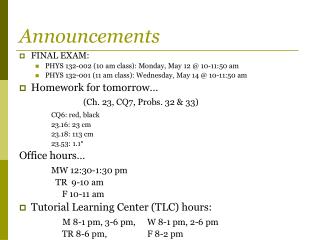
Announcements 4/11/11 • Prayer • Wednesday: Project Show & Tell. The lucky winners are: • Michael Meehan & Nick Prestwich – Doppler effect • Conrad Rosenbrock & Mike Abrahamson – evaporative cooling • Matt Pitts, Marcus Holden, Cody Petrie – refraction of light • Alan Snow – demos: air & water “whirlpools” You will present in that order; a 10 minute cut-off for each group. • Final exam: Sat, Apr 16 – Wed Apr 20, in Testing Center • Final exam review – On Thurs or Friday. Vote for times! FoxTrot, by Bill Amend
HW 37-3: Elastic Collision 1 kg 2 kg 1 kg 2 kg v1,after = ? 9 m/s v2,after = ? 0 m/s 3 m/s 6 m/s ? Check: (1)(9) + (2)(0) = -(1)(3) + (2)(6) 9 = 9 5 m/s 2 kg 2 kg 1 kg 1 kg 1 m/s 8 m/s 5 m/s 4 m/s ? Check: (1)(4) - (2)(5) = -(1)(8) + (2)(1) -6 = -6
Elastic Collision 1 kg 2 kg 1 kg 2 kg 0.3 c 0.9 c 0.6 c 0 m/s ? Check: (1)(0.9) + (2)(0) = -(1)(0.3) + (2)(0.6) 0.9 = 0.9 Is momentum conserved??? 0.5 c 2 kg 2 kg 1 kg 1 kg 0.14 c 0.70 c 0.5 c 0.73 c ? Check: (1)(0.73) - (2)(0.5) = -(1)(0.70) + (2)(0.14) -0.27 = -.41 Х
Relativistic Momentum • “The Truth”:
Momentum, Sgmv, is conserved in every reference frame!!! (disclaimer: has to be elastic collision) Elastic Collision 1 kg 2 kg 1 kg 2 kg 0.78 c 0.9 c 0 m/s 0.40 c g = 2.29 g = 1.09 g = 1.60 ? Check: (2.29)(1)(0.9) + 0 = -(1.09)(1)(0.4) + (1.60)(2)(0.78) 2.06 = 2.06 0.5 c 1 kg 2 kg 1 kg 2 kg 0.73 c 0.5 c 0.46 c 0.75 c g = 1.46 g = 1.15 g = 1.51 g = 1.13 ? Check: (1.46)(1)(0.73) – (1.15)(2)(0.5) = -(1.51)(1)(0.75) + (1.13)(2)(0.46) -0.095 = -0.095
Thought Question • What is the maximum momentum that a particle with mass m can have? • p = mc • p = 2 mc • p = 0.5 mc • There is no maximum momentum • None of the above
Momentum vs. Velocity Why do they agree at small velocities?
Reading Quiz • If m is the rest mass of an object, what does mc2 equal? • The gravitational energy of an object • The kinetic energy of an object • The potential energy of an object • The rest energy of an object • The total energy of an object
Relativistic Energy • Momentum Force (F = dp/dt) • Force Work (W = Fdx) • Work Energy (Ebef + W = Eaft) For mass = 1 kg Result: Correct KE KE (joules) ½ mv2 v/c Why can’t anything go faster than c?
A Word About Units • eV • MeV • MeV/c2
Thought Question • Hydrogen atoms consist of one electron which is bound to a proton by electromagnetic forces. If I very carefully weigh a hydrogen atom, what will I get? • The mass of an electron plus the mass of a proton • Something a little BIGGER than (a) • Something a little SMALLER than (a) • Something entirely different from (a) Ebef + W = Eaft
Thought Question • A nuclear power plant generates 10 million Watts of power nonstop for a day. How much less do the fuel rods weigh at the end of the day? • around 0.0001 grams • around 0.01 grams • around 1 gram • around 0.1 kg • around 10 kg Nuclear power is not alone in converting mass to energy, ALL power sources do this!
Elastic Collision 1 kg 2 kg 1 kg 2 kg 0.40 c 0.9 c 0 m/s 0.78 c g = 2.2942 How did I find out the two speeds after the collision? Conservation of momentum: Conservation of energy:
Elastic Collision 1 kg 2 kg 1 kg 2 kg 0.40 c 0.9 c 0 m/s 0.78 c g = 2.2942
Relationship between E and p • Classical: KE = ½ mv2 = ? (in terms of p) • Relativistic: E = gmc2 = ? (in terms of p) What if m=0? ? Proof: