Solids, Liquids and Gases
60 likes | 189 Vues
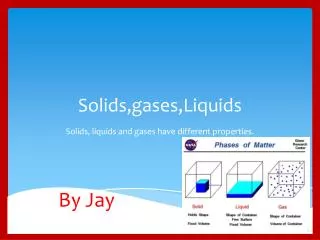
This work explores the fundamental characteristics of solids, liquids, and gases, highlighting their unique properties and interactions. Solids exhibit strong forces of attraction among tightly packed particles, maintaining their shape and volume. Liquids possess moderate attraction forces, allowing them to flow while retaining a fixed volume but taking the shape of their container. Gases have negligible attractive forces, enabling particles to move freely and fill any available space. This analysis underscores human ingenuity in measuring and understanding different states of matter.


Solids, Liquids and Gases
E N D
Presentation Transcript
Solids, Liquids and Gases By: Amna Al Mannai, Mariam AL-Khalifa,Shamma AL Hitmi, Sharefa Al Dosari
Areas of interaction • Areas of interaction = Human ingenuity • Humans have come up of ways to measure matter. • Can you describe them?
Liquids have some forces of attraction between particles. The particles are always held together but free. Sometime they stick together. • Liquids can’t be the same shape and sometimes they form puddles. • They can’t be compressed easily. Liquids
Solids has strong forces of attraction between particles. They're always closely together. Sometimes they move a bit. • Solids are different shapes, and cant flow like liquids. • Solids are usually crowded together. There are lots of particles in volume. Solids
Gasses have no forces of attraction between particles. They are always far apart and can move quickly in different direction. • The particles are not many in a large volume. • Gasses always change shape and will grow bigger to fill a container. Gases