Download
1 / 35
350 likes | 452 Vues
The Renaissance, spanning from 1050 to the late 1500s, marked a profound transformation in art, architecture, and intellectual life across Europe. This era celebrated humanism, reviving classical antiquity and promoting individual potential and secular themes. Notable artists like Botticelli, Michelangelo, and Leonardo da Vinci pioneered techniques such as perspective and realism, enhancing the emotional depth of their works. Influential city-states like Florence, backed by powerful patrons like the Medici, fostered commerce, creativity, and innovation, laying the groundwork for modern Western culture.

E N D
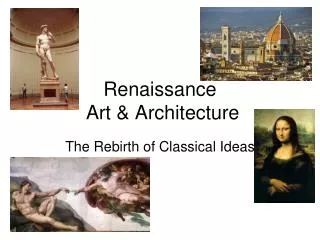
Renaissance Art & Architecture The Rebirth of Classical Ideas
Background & Phases • 1050 – 1350 • Population growth • Economic development • City – states • 1200 – late 1500s • Artistic achievement Bellini: Sacra Conversazione
Intellectual Development • Humanism: Glorify Human Form & Potential • Revival of classical antiquity • Individualism • Secular focus Titian: Assumption of the Virgin
Renaissance Italy • City-States • Power People • Medici (F) • Este (Ferrara) • Sforza (M) • Doge (V) • Pope (PS)
Florence • Commerce / Trade • Banking: Medici • Textile • Patronage
Renaissance Art: Techniques • Religious >> Secular subjects • Realistic • Perspective • Movement • Symmetry • Proportion Ghirlandiao: Adoration of the Shepherds
Medieval Flat Religious Static Renaissance 3-D Secular / Human focus Movement Medieval v. Renaissance Ghirlandaio: Angel Appearing to Zacharias
Giotto de Bondone: The Mourning of Christ • Florentine School * Fresco * Individuals
Massaccio: Tribute Money • Florentine School * Perspective * Realism
Sandro Botticelli: Madonna of the Magnificat • Expression Botticelli Face Emotional • Double focal points: Crown + Book
Major Artists: Ninja Turtles! Raphael – Michelangelo – Donatello – Leonardo
Raphael: Pope Leo X with Two Cardinals1518 • Vatican Murals Commissioned by Pope Julius II • Leo X = Julius II successor • Focal Point = Face
Raphael: The School of Athens • In the Vatican: Stanza della Signatura • Blending of Greek + Renaissance • Symmetry • Perspective • Depth • Light
Leonardo da Vinci • Renaissance Man • Multi-talented • Anatomy, mechanics, art, astronomy, weaponry… • China?
Leonardo: The Last Supper • Fresco * Symmetry * Individual Expression
Leonardo: Mona Lisa • Symmetry • “Sfumato” • Blur • Blend • Mystery • The Grin
Leonardo’s Notebooks • Vetruvian Man • Anatomy advances painting & sculpture
Michelangelo: Sistine Chapel • M = sculptor, painter, architect • Commissioned by Pope Julius II 1508 • Scaffold, personally completed • Old & New Testament reflects the Renaissance Era
Renaissance Sculpture • Classical Realism • Free standing • Marble & Bronze • Full body, busts & reliefs
Humanism & Individuality • Individuality portrayed in details
Ghiberti’s Doors - Florence • 1423, Florentine, he was only 23! • Bronze cast + gilding • 20 yrs N doors • 25 yrs E doors • “Creation” • Realism
Donatello’s David • Free standing nude • Proportion of human form • 5’ tall, After beating Goliath
Michelangelo’s David • Marble • 16’ tall • Details • As David decides to battle Goliath • Classical style, details
Renaissance Architecture • Columns • Arch • Dome • Harmony via proportion • The Circle is key • Math!
Church & Architecture • RCC builds to draw people • Tells the Biblical narrative • Visual & Symbolic
Church Architecture: Florence • Santa Maria del Fiore begun 1294 by Arnolfo di Cambio, died 1302 • Began cupola (cup shaped dome)
Church Architecture: Florence • Filippo Brunelleschi, 1418 figured out how to complete… ever decreasing circles with ribs to bear weight • Scaffolding upwards
Michelangelo hired by Pope Paul III in 1546… worked until death in 1564 Inside St. Peter’s: High Altar Nave Ceiling Roman arches Under Dome Single dome with arch support Church Architecture: St. Peter’s
Church Architecture: Bramante’s Tempietto • Renaissance “Greatest Architect” • Commissioned by K+Q of Spain: Ferdinand & Isabella • St. Peter’s death site • Doric columns + Roman dome, 15’ diameter
Renaissance Writers Voice of Humanism Dante Alighieri – Petrarch – Boccaccio - Castiglione
Renaissance Writers • Dante 1265-1321 • Divine Comedy Allegory • Vernacular • Petrarch1304-1374 • Sonnets in Italian • Boccaccio1313-1375 • Decameron = Plague • Castiglione1478-1529 • The Courtier = model
Northern Renaissance • Began in Flanders >> Holland • Erasmus 1466-1536: reconcile Christian character w/ Humanism… Colloquies, Adages, new Bible A. Dűrer – Hans Holbein (Young) – van Eyck
Northern Renaissance • Dűrer (G) 1471-1528 • Woodcuts • Mass Marketing • Holbein the Younger (G) 1497-1543 • Portraits, Henry VIII • Expressions • Van Eyck (Flem) 1390-1441 • Oil Paint developer • Realism possible
English Renaissance: Elizabethan Era • G. Chaucer • Canterbury Tales: Vernacular • Sir Th. More • Utopia: Ideal place of virtue • Spenser • Faerie Queen: Ode • Marlowe = plays • Shakespeare • Comedy, tragedy, morality
Renaissance Impact • Genius of humanity all at once… why? • Changed art & architecture forever • Individualism drives future thought