Empowering Young Minds Through Inquiry and Personalized Learning
Explore the power of inquiry-based learning in childhood development as inspired by Eleanor Roosevelt's philosophy. This interactive Makerspace session encourages young learners to experiment with playdough to understand circuits while embracing a trial-and-error approach. Participants will engage in discussions surrounding collaborative practices and the importance of self-organization in learning environments. Discover ways to ignite curiosity and personal questions that drive discovery and creativity, reinforcing the notion that children can teach themselves through exploration and community learning.

Empowering Young Minds Through Inquiry and Personalized Learning
E N D
Presentation Transcript
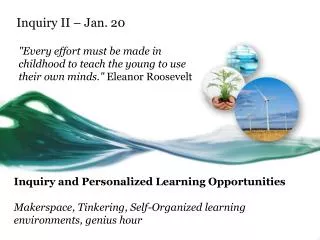
Inquiry II – Jan. 20 "Every effort must be made in childhood to teach the young to use their own minds." Eleanor Roosevelt Inquiry and Personalized Learning Opportunities Makerspace, Tinkering, Self-Organized learning environments, genius hour
Walk-in Activity • Goal: Develop an understanding of the properties of the different types of playdough through attempting to create a simple circuit • ONE rule – do not connect the LED lights directly to the batteries... They must only make contact with dough • Prior knowledge – how a simple circuit works
Checking in • Questions or comments about Inquiry Project? • Questions or comments about Practicum? • Collaborative Practice Discussion
Curiousity and Questions • Questions can be windows to great instruction but not the other way around • Embrace the mess – trial and error everyday • Practice Reflection – what we do is important, it deserves our care and our revision http://www.ted.com/playlists/125/tv_special_ted_talks_educatio.html
The Power of Questions • In real life, the pursuit of personally important questions is what leads to new discoveries, creations, or realizations (Arnold, 1995; Gardner, 1998 in Falk & Blumenreich, 2005 p.1)
Inquiry • awaken learners’ own questions and use these as the driving force for learning (Falk & Margolin, 2005). • Vs • instructing learners how to search for answers to predetermined questions.
Links to PracticeTeacher as a questioner, a knower, and a doer.
Reference Falk, B., & Blumenreich, M. (2005). The power of questions. Heinemann. Chapter 1: Making the Case for Teacher Research, pp. 4-11. http://www.heinemann.com/shared/onlineresources/E00698/chapter1.pdf The complete book is available in the education library at: http://webcat1.library.ubc.ca.ezproxy.library.ubc.ca/vwebv/holdingsInfo?bibId=3188325
Self-Organized learning Environments SugataMitrahttp://www.hole-in-the-wall.com/
How do you feel about this statement:Children in groups can teach themselves almost anything.http://www.ted.com/talks/sugata_mitra_shows_how_kids_teach_themselves.html
Self-Organized learning Environments SugataMitrahttp://www.hole-in-the-wall.com/