Java Inheritance and Types Review Session
Understand inheritance facts, constructors in subclasses, apparent vs real types, casting, syntax vs semantics in Java programming. Get ready for your final exam!

Java Inheritance and Types Review Session
E N D
Presentation Transcript
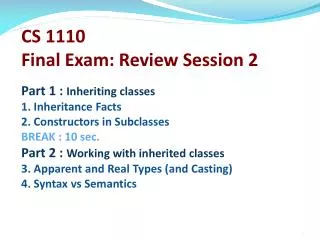
CS 1110Final Exam: Review Session 2Part 1 : Inheriting classes1. Inheritance Facts2. Constructors in SubclassesBREAK : 10 sec.Part 2 : Working with inherited classes3. Apparent and Real Types (and Casting)4. Syntax vs Semantics
Object equals(); toString(); Creature name Bird canFly() Bird(String n) Penguin canFly() Penguin(String n) Folders! • Penguin z = new Penguin(“”); a0 z a0
CS 1110Final Exam: Review Session 2Part 1 : Inheriting classes1. Inheritance Facts2. Constructors in SubclassesBREAK : 10 sec.Part 2 : Working with inherited classes3. Apparent and Real Types (and Casting)4. Syntax vs Semantics
Inheritance Facts • A subclass inherits ALL components (fields and methods) from the super class. • Even private fields are inherited; they appear in each object. • What makes them private, then? • A subclass can override methods. • A subclass should not override fields. It is called "shadowing the variables”. We have never seen a good use of it. Don’t do it.
Inside-out rule • To find a variable, search outward through enclosing constructs until the declaration of the variable is found. • In the folder representation, go bottom-up!
Constructors in subclasses • The following can only appear as the first statement in a constructor: • this(...); // call another constructor in this class • super(...); // call a constructor in the super class • If there is no explicit constructor call in a constructor,Java inserts super();. • What if the super class does not have a default constructor? Note: If there is no explicit constructor declared in a class, Java inserts a default constructor.
CS 1110Final Exam: Review Session 2Part 1 : Inheriting classes1. Inheritance Facts2. Constructors in SubclassesBREAK : 10 sec.Part 2 : Working with inherited classes3. Apparent and Real Types (and Casting)4. Syntax vs Semantics
CS 1110Final Exam: Review Session 2Part 1 : Inheriting classes1. Inheritance Facts2. Constructors in SubclassesBREAK : 10 sec.Part 2 : Working with inherited classes3. Apparent and Real Types (and Casting)4. Syntax vs Semantics
Apparent & Real Types (and Casting) • Real type of a variable • The type of the object it’s referring to. • Apparent type of a variable: • The type of the variable…-_- • Used to tell if a reference is legal (if not, program won't compile.). • v.field / v.method(...) is legal only if field / method() is defined in or inherited by the apparent class of v. • Casting: changing of the apparent type • What are the restrictions?
Syntax VS Semantics • The validity of a statement should be checked by: • SYNTAX (grammar; rules for legal programs) • SEMANTICS (meaning; how legal programs are executed). • Ex) Assess the following statements: • a == b • a.equals(b) What makes one correct, but not the other?
Running Example! • Dr Java