
1 / 5

Understanding DFA, NFA, and Turing Machine Acceptance Criteria in Automata Theory

This text explores the concepts of Deterministic Finite Automata (DFA), Nondeterministic Finite Automata (NFA), and Turing Machines (TM), along with their acceptance criteria for strings. It details several constructs, such as how to simulate one automaton with another, convert NFAs to DFAs, and analyze the acceptance conditions. Key algorithms like the symmetry difference and graph marking for reachability are discussed, emphasizing the decidable nature of various operations and the limitations of computational models concerning halting problems.
manning
Télécharger la présentation

Understanding DFA, NFA, and Turing Machine Acceptance Criteria in Automata Theory

An Image/Link below is provided (as is) to download presentation Download Policy: Content on the Website is provided to you AS IS for your information and personal use and may not be sold / licensed / shared on other websites without getting consent from its author. Content is provided to you AS IS for your information and personal use only. Download presentation by click this link. While downloading, if for some reason you are not able to download a presentation, the publisher may have deleted the file from their server. During download, if you can't get a presentation, the file might be deleted by the publisher.

E N D

Presentation Transcript


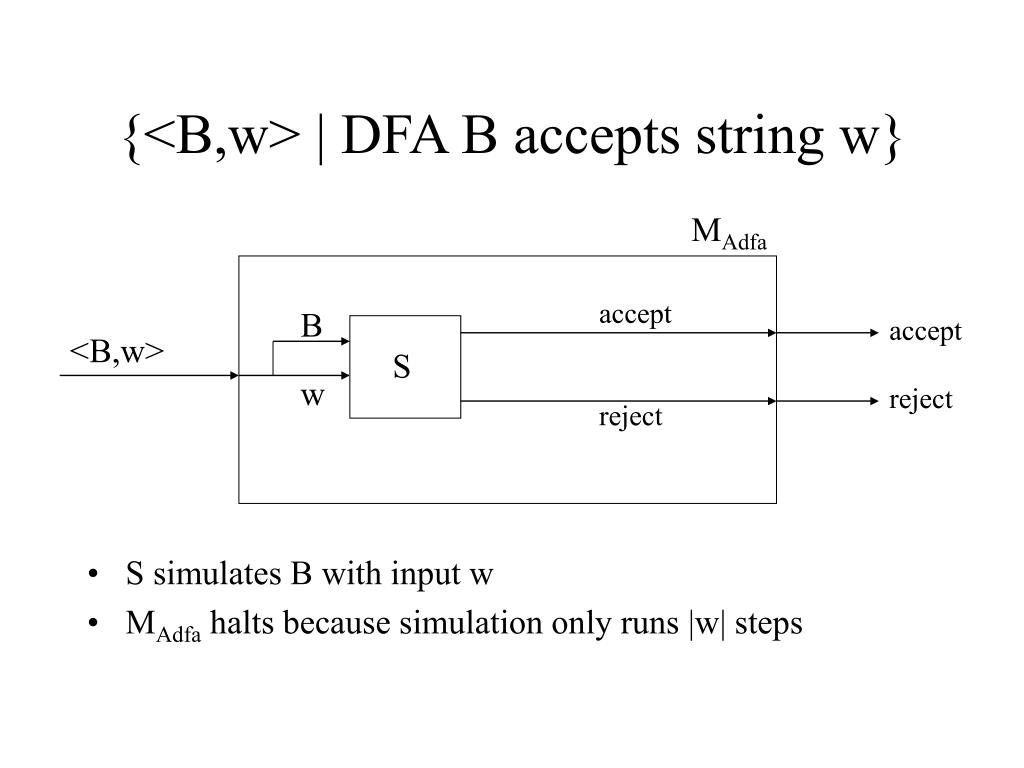
  1. {<B,w> | DFA B accepts string w} MAdfa accept B accept <B,w> S w reject reject • S simulates B with input w • MAdfa halts because simulation only runs |w| steps

  2. {<N,y> | NFA N accepts string y} MAnfa <N,y> accept C <P,y> accept MAdfa reject reject • C converts NFA N to DFA P (known algorithm) • MAnfa halts because C and MAdfa are decidable and are run a finite number of times (once each, actually)

  3. {<A> | A is a DFA, L(A) = { } } MEdfa <A> accept < q > accept GM Z reject reject • GM (graph marker) marks all accepts states reachable from init state and produces that list as < q > • Z accepts if input is empty; otherwise rejects • MEdfa halts because GM, Z are decidable and are run a finite number of times (once each)

  4. {<A,B> | DFAs A & B, L(A)=L(B)} MEQdfa <A,B> accept < C > accept SD MEdfa reject reject • SD creates the DFA C as symmetric difference of L(A), L(B) • MEQdfa halts because SD, MEdfa are decidable and are run a finite number of times (once each)

  5. {<M,w> | TM M accepts string w} MU <M,w> accept accept S reject reject • S simulates M on input w • MU doesn’t always halt because M could loop forever on w • But, problem is even worse than that: some problems can’t even be encoded using our formal system

More Related