Understanding Cnidarians: Facts, Classification, and Life Cycle
Cnidarians, a diverse phylum known for their unique body structures and behaviors, include over 10,000 species such as jellyfish, corals, and anemones. Characterized by their hollow guts, radial symmetry, and specialized stinging cells (cnidae), these organisms inhabit various marine environments. Cnidarians exhibit two main body forms: polyps and medusae, with life cycles that can vary significantly. Their simple nervous system, lack of circulatory system, and methods of asexual and sexual reproduction highlight their fascinating biology.


Understanding Cnidarians: Facts, Classification, and Life Cycle
E N D
Presentation Transcript
Cnidarians Sandra Benito J.H., 9B
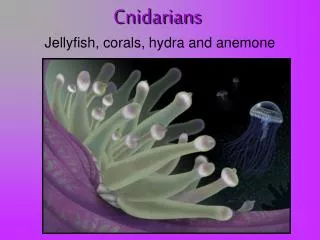
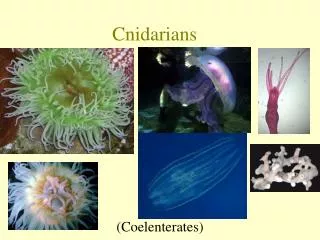
Name: Cnidarians • Before: Coelenterata phylum,meaning "hollow guts." • Included certain ctenophores and sponges. • From the Greek "cnidos," meaning "stinging nettle.“ • Number of species currently existing: 10,105 species • Taxonomic Classification: • Domain:Eukaryota • Kindom: VI. Animalia • Phyla: B.Cnidaria • Class:Cubozoa (Box jellies) Swimming • Class:Scyphozoa (Jellyfishes) Swimming • Class:Anthozoa (Anemones and corals) Sessile • Class: Hydrozoa (Hydra) Both
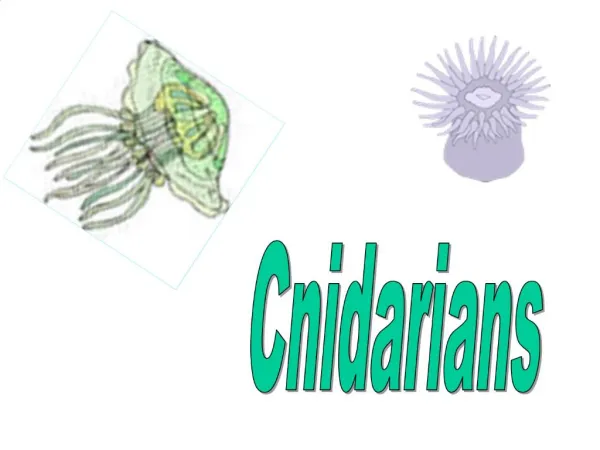
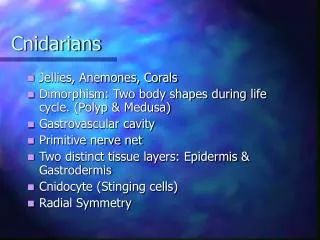
Found in marine environments. • Two basic body types: • Polyps • Medusae • Tentacles • Venomous cell organelles (cnidea) • Gastrovascular cavity • Three-layered body; epidermis, mesoglea and gastrodermis • Radially symmetric • Carnivorous • Solitary or colonial • Asexual and/or sexual reproduction • Nervous system • No cardiovascular system
Fossil history: • Vendian/Ediacaran period • 650 to 540 million years ago • Soft-bodied organisms • Cambrian period - coral fossils • Early Ordovician - more developed corals
Life span is undetermined. • Life cycles vary by class and species • Some skip stages (e.g. Hydra) • Alternation of generations (e.g. Obelia) • Asexual reproduction medusae grows on external tissue • Matured medusae swim away • Sexual cells released • Eggs are fertilized • Zygote/planula settles and develops into a polyop
Absorbdissolvedorganicchemicals • Filterfoodparticles • Nutrientsfromendosymbioticalgae • Predate • Crustaceans and plankton • Medusae forms sink on top of the prey • Gastrodem layer releases enzymes that kill the prey • Cellsabsorbthenutrients • Nutrients spread by diffusion or mobile cells • Indigestible remnants are ejected
No circulatory system • No respiratoryorgans • Absorb/expel O and CO2 into water • Water in digestive cavity is expelled
Simple sensorysystem • Net of nerves made of sensitive neurons • Sensitive neurons are connected by chemical synapse • Neuron sends neurotransmitter (chemical) to cell group
Bibliography • New Oxford American Dictionary • http://en.wikipedia.org/wiki/Cnidaria • http://waynesword.palomar.edu/trnov01.htm#animals • http://www.buzzle.com/articles/jellyfish-facts-for-kids.html • http://animals.about.com/od/cnidarians/p/cnidaria.htm • http://nationalzoo.si.edu/Animals/Invertebrates/Facts/cnidarians/default.cfm • http://www.oceaninn.com/the-nature-preserve/cnidarians/ • http://mapress.com/zootaxa/2011/f/zt03148p012.pdf • http://animals.about.com/od/cnidarians/ss/cnidarians.htm • http://www.ucmp.berkeley.edu/cnidaria/cnidariafr.html • http://www.angelfire.com/moon2/asciencems/ • http://zoology.muohio.edu/crist/Zoo312/Cnidaria.html • http://faculty.clintoncc.suny.edu/faculty/michael.gregory/files/bio%20102/bio%20102%20lectures/nervous%20system/nervous1.htm