Understanding Internet Routing: Static vs Dynamic, BGP, OSPF, RIP
Learn about different aspects of internet routing, including static and dynamic routing, BGP, OSPF, and RIP protocols, routing metrics, and multicasting in the global internet infrastructure.

Understanding Internet Routing: Static vs Dynamic, BGP, OSPF, RIP
E N D
Presentation Transcript
Static Routing • manually configured routes that do not change • Used by hosts whose routing table contains one static route describing the network to with the host is attached • a default route directs all other traffic to a specific router (fig 25.1)
Dynamic Routing • routing tables can change automatically over time via information learned via routing messages from other routers. • Each router learns about destinations other routers can reach, and informs other routers about destinations that it can reached (fig 25.2)
Routing in the Global Internet • the Internet uses a 2-level routing hierarchy • Routers and networks are divided into groups where each group is known as an autonomous system (a contiguous set of networks and routers all under control of one administrative authority). • All routers within a group(autonomous system) exchange routing information while one router in each group summarizes the information before passing it to other groups.
Internet Routing Protocols • Interior Gateway Protocol (IGP) • eg. RIP, OSPF, IGRP: used by routers within an autonomous system • Exterior Gateway Protocols(EGP) • eg.BGP: used by a router in one autonomous system to exchange routing information with a router in another autonomous system (fig 25.3)
Routing Metrics • eg. hop count, administrative cost, throughput, delay. • Used by interior gateway protocols but not by exterior gateway protocols due to existence of different metrics. • Within an autonomous system, IGP software uses a routing metric to choose an optimal path to each destination. • EGP software finds a path to each destination, but cannot find an optimal path because it cannot compare routing metrics from multiple autonomous systems.
Border Gateway Protocol (BGP) • routing messages among autonomous systems contain routes, each of which is described as a path of autonomous systems ( eg. route to autonomous system 34 is achieve via autonomous systems 17, 2, 56, and 12. • Provision for policies: manager can configure BGP to restrict routes advertised to outsiders • Each autonomous system is classified as a transit system if it agrees to pass traffic through to another autonomous system or as a stub system if it does not • Uses TCP for reliable transport of routing messages • Used by all ISPs to exchange routing information with each other and from an authoritative route server (which has a copy distributed database of all possible destinations in the Internet with information about the ISP that owns each destination)
Routing Information Protocol (RIP) • implemented by a program called routed • hop count metric with origin-one counting ( ie. A directly connected network is 1 hop away, not 0) • uses unreliable transport (UDP) • uses broadcast(RIP version 1) or multicast(RIP version2) for message delivery • support for default route propagation
Routing Information Protocol (cont.) • uses distance-vector algorithm • RIP advertises the destinations it can reach along with a distance to each destination • adjacent routers receive the information and update their routing tables • allows hosts to be operate in passive listen-only mode ( ie. no advertising) • RIP packet format (fig 25.5) • drawbacks of RIP include large routing messages, slow propagation of route changes (one router at a time), and limited scalability.
Open Shortest Path First Protocol (OSPF) • scales well to large organizations • designed as an interior gateway protocol • full CIDR and subnet support • authenticated message exchange • can import routes from BGP • Uses hierarchical routing by dividing routers and networks in an autonomous system into subnets known as areas. • Each router is within a given area exchange link-status messages via broadcasts. • Summarized routing information are exchanged by one router in each area with routers in other areas.
Open Shortest Path First Protocol (cont) • uses link-state routing algorithm. • Each router must periodically probe adjacent routers and then broadcast a link-status message • routers that receive the message use Dijkstra’s SPF algorithm to compute the shortest paths using it local copy of network graph(fig 25.6) .
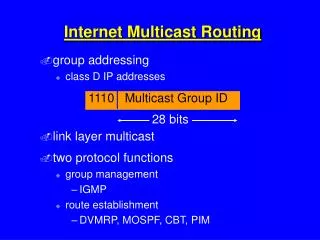
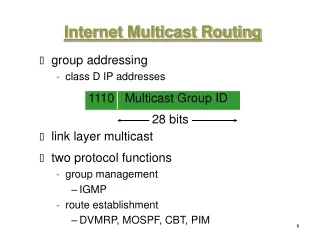
Multicasting • an application running on any computer can join a multicast group at any time and begin receiving a copy of all packets sent to the group. • To join or leave a group, the computer informs a nearby router via IGMP (Internet Group Multicast Protocol). • To leave a group, the computer informs the local router that it is no longer participating in the group.
Multicasting (cont) • An IP multicast group is anonymous • sender and receiver do not know the identity or the number of group members • routers do not know which applications will send a datagram to a group since any application on any computer can send a datagram to any multicast group at any time. • Membership in a multicast group only defines a set of receivers • sender does not need to join a multicast group before sending a message to the group. • Multicast packets are forwarded using techniques such as flood-and-prune, configuration-and-tunneling, or core-base discovery.
Multicast routing protocols • DVMRP (distance vector multicast routing protocol) • used by Unix program mrouted and Internet Multicast backBONE (MBONE) • CBT (Core Base Trees) • PIM-SM (protocol independent multicast–sparse mode) • PIM-DM (protocol independent multicast–dense mode) • MOSPF(multicast extensions to the open shortest path first protocol)