
The Scientific Process
E N D
Presentation Transcript
Top Reasons for Research Methods • Develop a critical thought process • Develop research skills • Distinguish fact from non-factual evidence • Develop an understanding for research reports • Develop an understanding for the process of research
Distinguishing Between Fact and Fiction • Parity Claims -- The careful wording of a statement that gives the impression that one item is better than the other. These don’t always mean that one item is statistically better than the other.
Processing Report Information • Research methods helps students understand the data that a report or advertisement is claiming • Three Types of Information • Parity Claims • Testimonials • Statistical Information
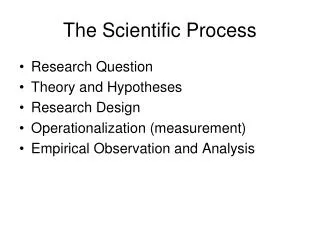
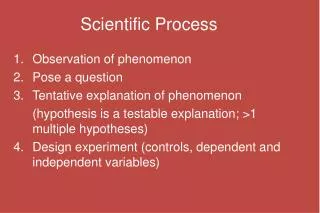
Research and Knowledge • Research gathers the information necessary to answer questions and make decisions • The processes of gaining knowledge • Ask questions • Make initial observations • Conduct systematic investigations • Analyze the information gathered • Interpret the findings • Integrate the findings with previous knowledge
Theories • Theories are statements that explain a set of facts • Theories are strengthened by corroborating evidence collected from research • Review the theories on pages 16 - 22 • A theory’s merit can be evaluated by: • The precision of the theories description • The simplicity of the conditions needed to meet the theory • The testability of the theory through empirical research
Hypotheses and Knowledge • A hypothesis is the prediction statement in research related to a theory • They determine the nature of the research to be conducted • They state the expected outcomes of the research
Types of Research • Descriptive research • Research that explains an occurrence without stating cause or prediction • Predictive research • Research that shows relationships between variables and what will likely happen • Control related research • The natural step after predictive research that shows how outcomes can change by controlling variables • Explanative Research • Research that explains WHY the outcomes occur
The Use of Reason for Answers • Inductive Reasoning • Observations from specific research that can be generalized to a larger factors • Progress from the specific to the general • Deductive Reasoning • Observations from a general factors that can explain specific factors • Progress from the general to the specific
The Types Research • Basic Research • Applied Research • Qualitative Research • Quantitative Research • Descriptive Research • Experimental Research • Longitudinal Research • Cross-sectional Research
The Nature of the Research • Introduction • Review of Literature • Trends in the Literature • Determine Weak Areas in the Literature • Special Problems • Special Populations
Choosing & Defining the Problem • Interesting to YOU • Enhancement of Previous Research • New Technologies • Areas of Weakness in Current Research • Current Trends • Recent Discoveries
Review of the Literature • Introduction Describing Each Area of the Literature Pertinent to Your Research • Subsections of Each Area • Summary of Each Article Pertinent to the Area • Final Summary of the Overall Findings from the Articles • Summary that Links All Articles to the Introduction and Your Research
Research Design • Time Frame • Experimental Research • Descriptive Research • Historical Research • Qualitative Research
Writing the Proposal • Introduction • Statement of the Problem • Purpose of the Study • Need for the Study • Limitations • Strong Points • Assumptions • Hypothesis • Definitions
Writing the Research Proposal • Choosing & Defining the Problem • The Nature of the Research • Research Design • Defining the Subjects • Data Collection Methods • Data Analysis
Defining the Subjects • Gender • Age • Race • Special Population
Data Collection Methods • Survey • Cohort Data • Cross Sectional Data • Case Study • Observational • Previously Collected Data
Data Analysis • Level of Significance • Descriptive (Means & SD) • Correlation Analysis • ANOVA • MANOVA • Regression • Categorical Modeling
Experimental Procedures • General Description of Procedures • Subjects • Specific Measurement Techniques • Instrumentation • Data Analysis Procedures
Disseminating Knowledge • Once data is collected, the findings must be distributed so that others can benefit from its knowledge • Three ways to disseminate research findings • Presentations • Poster Presentations • Written Reports
Presentations • Presentation of findings to groups or organizations in a slide format • The research can receive feedback from peers prior to publishing the results • Current research and recent research can be presented in this manor
Poster Presentations • A brief written account of the research in a poster format • Usually presented in a forum with other researchers • Allows for personal feedback and questions from peers
Written Reports • The permanent record of the research • The research and results are described in detail • Publications can be accessed by the general public
The Format of For Presenting Research • Abstract • A brief one page description of the research and the findings • Introduction and Literature review • The lead in or “hook” that explains the previous research and the current hypothesis and research question • Methods and Procedures • A cookbook description of how the research was conducted • Results • The data analyses and findings • Discussion and Conclusions • Relating the results to the hypotheses and research question