Download
1 / 9
90 likes | 247 Vues
This lesson explores the consequences of population explosion on our planet, emphasizing how an increasing human population leads to the depletion of non-renewable resources, more waste generation, and heightened pollution levels. Students will understand the exponential growth of the population, particularly in developing countries, the factors contributing to higher life expectancy, and how human activities such as urbanization and industrialization negatively impact air, water, and land quality. By the end of the lesson, students will grasp the critical relationship between population growth and environmental sustainability.

E N D
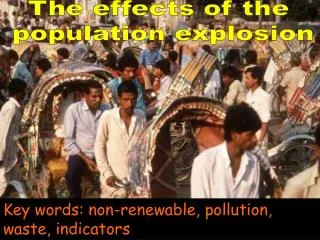
The effects of the population explosion Key words: non-renewable, pollution, waste, indicators
Objective • How does population increase affect the earth? • Success Criteria • By the end of the lesson I: • know that there are increasing numbers of people on the planet • can explain that an increase of people on the world increases the depletion of natural resources and produces more waste and pollution
Human impact on the environment Reduce the land available for plants and animals How does human activity affect the environment? Raw materials (inc. non-renewable) resources are being used up More waste is produced which (if not handled properly) may pollute air, water & land
Population growth There are about 6.6 billion people in the world and over 95 million babies are born per year – that is an average of three babies per second! Has the rate of population growth always been the same?
Exponential growth The human population is said to be growing exponentially. This means that the larger the population, the faster it grows. An increase in average life expectancy is largely responsible for the rapid increase in population. Why do people live longer than they did hundreds of years ago? • better healthcare (hospitals, medicines, vaccines) • more and better food • cleaner water • better sanitation The biggest increase in population is in developing nations, rather than developed nations. Why do you think is the case?
Predicting future growth rate Computer models can be used to make predictions about population growth by using assumptions about birth rate. Most analysts assume that birth rates will fall within the next 50 years. Why do you think this might happen? • decreased fertility • lack of resources • disease • war How important do you think predictions about climate change and unsustainable development are in the analysts’ calculations?
use moreraw materials use more land more people use more energy produce more waste and pollution minerals Using resources and producing pollution buildings, farms, quarries and dumps • Humans use land for • Building • Quarrying • Farming • Dumping • We pollute the • WATER – with sewage, fertiliser, toxic chemicals • AIR – with gas such as sulfur dioxide and smoke • LAND – with pesticides and herbicides (these can • be washed into the water) fossil fuels pesticides and herbicides sewage, fertilizer and toxic waste CO2, SO2, CO and smoke
Graphing Draw a graph from the provided information
Objective • How does population increase effect the earth? • Success Criteria • By the end of the lesson I: • know that there are increasing numbers of people on the planet • can explain that an increase of people on the world increasing the depletion of natural resources and produces more waste and pollution