Launch Vehicle Selection
This document outlines the strategies and considerations for selecting launch vehicles for missions to Low Lunar Orbit (LLO). The focus is on minimizing costs per kilogram through various launch vehicles, including Delta IV, Atlas V, Long March 2C/2E, PSLV, and Falcon 9 Heavy. Key technical aspects cover propulsion systems, mission operations, structural mass scale-up, and parking orbits at 400 km. The analysis also includes impact scenarios for different payload cases, emphasizing custom spring designs to optimize launch distances and handling of payload impacts.

Launch Vehicle Selection
E N D
Presentation Transcript
March 5, 2009 Launch Vehicle Selection ZarinahBlockton Mission Ops~Group Earth to LEO~Phase
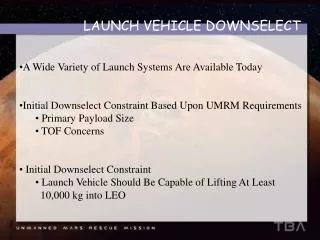
Arbitrary Payload Case • Goal: Minimize $/kg to LLO (low lunar orbit) • Additional Launch Vehicles • Delta IV (All configurations) • Atlas V • Long March 2C, 2E • PSLV • Falcon 9 Heavy • Iterate between propulsion and mission ops code • Notables • Biggest assumption ~ structural mass scale-up • Parking orbit = 400 km • Time of Flight = 351 days [Blockton] [OPS] <2>
[Blockton] [OPS] <3>
Back-up Slide [Blockton] [OPS] <4>
Back-up Slide [Blockton] [OPS]
Back-up Slide Spring Calculation PE = ½*k*x2 KE = PE KE = ½*m*v2 Vyf = Vy0 – gmoon*t ∆x = VX0*t [Blockton] [OPS]
Spring Cannon Conclusions 100g case (7.6kg ball)For 1s impact timewe can get to 720mand be under 30g's at impactFor .5s impact we can get to 180mand be under 30g's at impact 10kg case (18.5kg ball)For 1s impact timewe can get to 667mand be under 30g's at impactFor .5s impact we can get to 148mand be under 30g's at impact However if we launch to our maximum distance the length of the springs grows. Therefore here are my recommendations 100g case (7.6kg ball)D = 180m30g's at launch15g's at landing for 1s impact time30g's at landing for 0.5s impact time6m distance spring is extended 10kg case (18.5kg ball)D = 148.13m30g's at launch13g's at landing for 1s impact time27g's at landing for 0.5s impact time5m distance spring is extended I haven't found a spring that meets these requirements yet,however I think one could be custom made to meet our needs either in-house or through a contract company.If we can determine that using a spring that extends to a length over 6m is possible/feasible, then we could launch to a greater distance. As of right now the spring length and launch g's are the limiting factors in this design. <7>
Back-up Slide [Blockton] [OPS]
Back-up Slide [Blockton] [OPS]